Slides That Follow Your Voice: Spanish Accent Webinar
Marta, the agronomist of a cooperative, answers the question 40 members sent: how to keep trees planted for 500 millimetres of rain alive on 310. SAYA shows the slides full screen and turns them as the talk reaches them. Along the way the voice goes off script, corrects itself, restarts a sentence, pauses and skips a line.
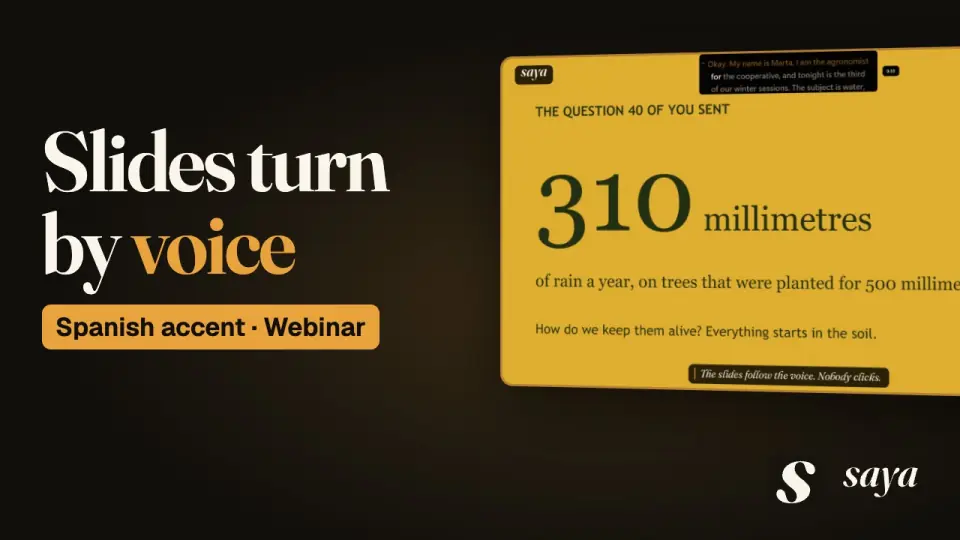
“The Tree That Writes Everything Down”, a scripted demo talk with slides on SAYA for Windows on a remote test server, in one take from start to finish, with opening and closing titles added. SAYA turns the slides as the talk reaches them. The voice reached SAYA through a virtual audio cable, not a room microphone. The accent name is the voice library's label.
Moments to watch
Select a time to play from there. A “…” marks where a quote starts or stops mid-sentence.
A slip and a fix1:17
From thirty millimetres falling, twenty, sorry, twenty-two left the field as runoff within two hours, and they took about one point four tonnes of topsoil per hectare with them. Joaquín …
Off script1:29
Joaquín says in the chat he wants to see the mud. Okay. Later. I did not believe this number either, I made the technician measure it twice, and the second time I stood in the rain with him …
A false start2:12
We use, we sow, the mix is... We use a mix of barley, vetch and a little mustard, sown in October at forty kilos per hectare, and we mow it, we do not plough it, in late March …
Said another way2:29
The cut material stays on the surface, as a mulch. In the second year, soil organic matter on the Cabezo plots went from zero point nine percent to one point three.
A skipped part3:50
A tree that is watered in June produces shallow roots, because it has no reason to go deeper. The …
Transcript
The words of the talk as the voice says them, including its asides and slips. The text on screen is the script. While the film plays, the current paragraph is marked.
Slide 1: Water
0:17Good evening, everyone, and welcome. I can see people still joining, so I will give it one more minute, and in the meantime, if you can hear me and you can see the slide with the olive tree, please type a yes in the chat. Just a yes, Joaquín, not your whole life. [laughs]
0:37Okay. My name is Marta, I am the agronomist for the cooperative, and tonight is the uh... the third of our winter sessions. The subject is water, and specifically the question that forty of you sent me in some form after the summer: how do we keep the trees alive on three hundred and ten millimetres of rain a year, when the trees were planted for five hundred?
Slide 2: 310 millimetres
1:00Let me start with what the soil is doing, because everything starts in the soil, no? In a conventional grove, bare, tilled, clean, a heavy rain of thirty millimetres in one hour runs off the surface almost entirely. We measured it on the Cabezo plots in October.
Slide 3: One storm, two plots: Cabezo, October
1:17From thirty millimetres falling, twenty, sorry, twenty-two left the field as runoff within two hours, and they took about one point four tonnes of topsoil per hectare with them. Joaquín says in the chat he wants to see the mud. Okay. Later. I did not believe this number either, I made the technician measure it twice, and the second time I stood in the rain with him holding the bucket, and my husband still asks about that evening. Where was I. The slide. Yes. The other plots. On the plots next door, where we have kept a living cover between the rows since twenty twenty-one, runoff from the same storm was six millimetres. Six. The other twenty-four went into the ground, where the trees can reach it in April. I have the photos, they are in the folder, I will not show them now because they are mostly mud.
2:08So, the first recommendation is the cover crop. We use, we sow, the mix is... We use a mix of barley, vetch and a little mustard, sown in October at forty kilos per hectare, and we mow it, we do not plough it, in late March, before it competes for the last of the spring water. The cut material stays on the surface, as a mulch.
Slide 4: First: the cover crop
2:32In the second year, soil organic matter on the Cabezo plots went from zero point nine percent to one point three. That does not sound like much. It is about twenty thousand litres more water held per hectare, every time it rains.
2:47The second recommendation is pruning for shade, not for size. We have been opening the canopy for decades, because that was the advice, and it was good advice in a Um... a wetter century. An open canopy lets the sun onto the soil under the tree, and in July that soil reaches fifty-five degrees.
Slide 5: Second: prune for shade, not for size
3:09We are now leaving the lower skirt of the canopy and taking height off the top instead. Yield in the first year drops by about eight percent. Yield in the third year, on the trial rows, was four percent above the control, percent above the control, without irrigation.
3:26Third, and this is the one that will make some of you close the window: stop irrigating the old trees in June. I know. [sighs] Three people have left. That is fine. Their trees will tell them in two years, the trees are more convincing than I am. Everyone who stayed, thank you, you are the brave ones, or you fell asleep, I cannot tell from here.
Slide 6: Third: stop irrigating the old trees in June
3:51A tree that is watered in June produces shallow roots, because it has no reason to go deeper. The same tree, given one deep irrigation in May and nothing in June, sends roots down to one point eight metres, where the soil is still wet from the winter.
4:07We have the root photographs, and they are not pretty, but they are convincing. I want to be honest about what we do not know. Three years is a short trial. The storm in October was one storm. My grandfather said the olive is the only tree that forgives you, but it writes everything down. I did not understand that until I started measuring. He never measured anything. He was right anyway, which is annoying.
Slide 7: What we do not know
4:34If the next two winters are dry, the cover crop will compete with the trees and we will have to mow earlier, and I will tell you so in this same session in a year.
4:44Questions in the chat, please, and I will take them in order. Joaquín, I can see yours already. Yes, you can put sheep on it. No, not in March. [laughs]
More demo films
 Singaporean accent, with slides“Useful in Both Directions” · 4:49
 Chicago accent, with slides“Point North with Great Confidence” · 5:11
 German accent, with slides“Nothing Left in the Machine” · 4:43
 Geordie accent, with slides“Label the Labels” · 4:33
 Chinese accent, with slides“The Shelves Come to You” · 4:59
 Yorkshire accent, with slides“We Shall See” · 4:24