Slides That Follow Your Voice: German Accent Product Launch
A factory that has made spindles for dental drills for 23 years launches the Null, a coffee grinder that took four years. SAYA shows the slides full screen and turns them as the talk reaches them. Along the way the voice goes off script, corrects itself, restarts a sentence, pauses and skips a line.
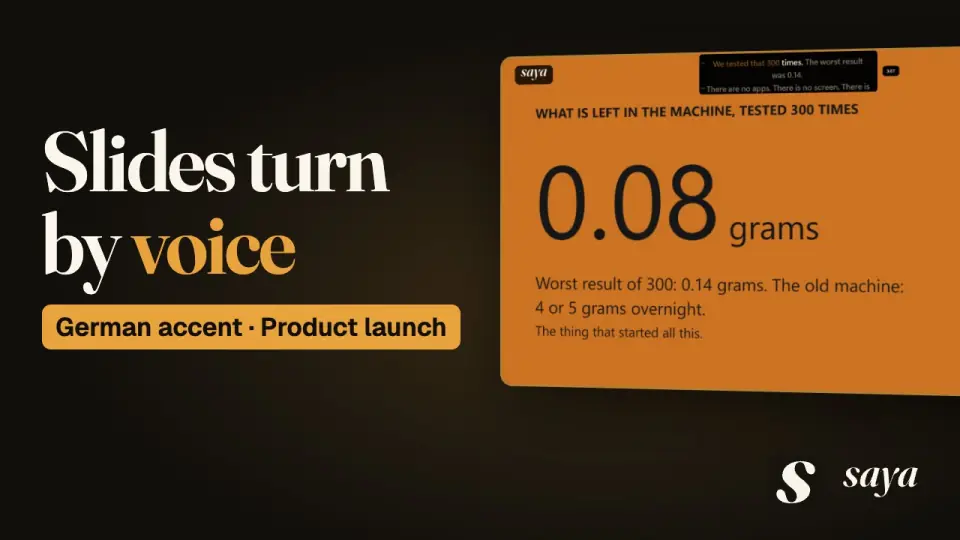
“Nothing Left in the Machine”, a scripted demo talk with slides on SAYA for Windows on a remote test server, in one take from start to finish, with opening and closing titles added. SAYA turns the slides as the talk reaches them. The voice reached SAYA through a virtual audio cable, not a room microphone. The accent name is the voice library's label.
Moments to watch
Select a time to play from there. A “…” marks where a quote starts or stops mid-sentence.
A slip and a fix0:41
If you have ever had a tooth drilled in this country, there is maybe a one-in-three chance that the part spinning at four hundred, no, four hundred thousand revolutions per minute inside your mouth was made in the …
Off script1:00
I have tried. I wrote to a magazine, in two thousand and nine, I think, or ten. I described the tolerances. I sent photographs. They wrote back, very politely, that their readers were dentists, and that dentists do …
A pause2:06
It took four years. Tonight I am showing you the result, and it is called the Null.
Said another way2:25
The burrs are held by a spindle assembly with a total runout of less than five microns, which is about one-twentieth of the width of a human hair, and which means that the grind size you set is …
A skipped part4:22
She also says I should have done this twenty years ago, and probably she is right, I do not know.
Transcript
The words of the talk as the voice says them, including its asides and slips. The text on screen is the script. While the film plays, the current paragraph is marked.
Slide 1: The Null
0:17Good evening, and thank you for coming to a factory on a Thursday. For the people who got lost on the way, the signs were made by our uh, our marketing department, and the marketing department is me, so, I accept the responsibility, and I will fix the signs tomorrow. [laughs]
0:35For twenty-three years this company made one thing. Spindles for dental drills. If you have ever had a tooth drilled in this country, there is maybe a one-in-three chance that the part spinning at four hundred, no, four hundred thousand revolutions per minute inside your mouth was made in the building behind me.
Slide 2: 400,000 rpm: spindles for dental drills
0:54It is not glamorous work. Nobody has ever written a magazine article about a dental spindle. I have tried. I wrote to a magazine, in two thousand and nine, I think, or ten. I described the tolerances. I sent photographs. They wrote back, very politely, that their readers were dentists, and that dentists do not want to think about the drill any more than the patients do. So. That was the end of my career in journalism. Where was I. Yes.
1:24But it taught us one thing to a depth that most companies never reach, and that thing is how to make two pieces of steel meet each other exactly, again and again, for twenty years.
1:37Four years ago my daughter, who runs a small café in Bremen, called me to complain about her coffee grinder. It was expensive, it was loud, and every morning the first cup was made from the coffee of yesterday, um, because four or five grams of grounds stayed inside the machine overnight. She said, you make things that spin for a living, can you not do better than this. And I said what every engineer says, which is, probably, how hard can it be. [chuckles]
Slide 3: A café in Bremen
2:06It took four years.
Slides 4-5: It took four years / What is inside
2:10Tonight I am showing you the result, and it is called the Null.
2:15The Null has a sixty-four millimetre flat burr set, cut from the same steel we use for the spindles, hardened to sixty-two on the Rockwell scale. The burrs are held by a spindle assembly with a total runout of less than five microns, which is about one-twentieth of the width of a human hair, and which means that the grind size you set is the grind size you get, on both sides of the burr.
2:39The motor turns at one thousand four hundred revolutions, slowly, on purpose, so the coffee does not heat up and the kitchen does not wake up. We measured it at sixty-eight decibels. The old machine in my daughter's café was eighty-four. In principle, you could run this one during a telephone call. No? It was a joke. A small one. I have not tried. I do not like telephone calls.
3:03And the retention, the coffee left inside after grinding, the thing that started all this, is zero point zero eight grams. We tested that three hundred times, that three hundred times. The worst result was zero point one four.
Slides 6-7: 0.08 grams left in the machine / No apps. No screen. One dial
3:20There are no apps. There is no screen. My son-in-law asked if it connects to his phone. I said, if you put the phone next to it, they are connected, in the sense that they are both in the kitchen. He did not laugh either. He drinks the coffee. There is one dial, which is marked in microns and not in numbers that somebody made up, and there is a switch. If you lose the manual, you have lost four pages, and the second page is a drawing of the switch.
3:48The price is seven hundred and ninety euros, which is a great deal of money for a coffee grinder and a very small amount of money for a precision spindle. We are building, no, we will, we will build... We will build twelve hundred units this year, here, in this building, and every one of them will be tested on the same bench you can see through the window to my left. The first one hundred are already sold, mostly to people who were angry about their first cup of the day. I understand them.
Slide 8: 790 euros
4:19My daughter has serial number one. She also says I should have done this twenty years ago, and probably she is right, I do not know. [sighs]
Slide 9: Serial number 1
4:29Thank you. There is coffee at the back, and I know exactly how much is left in the machine.
More demo films
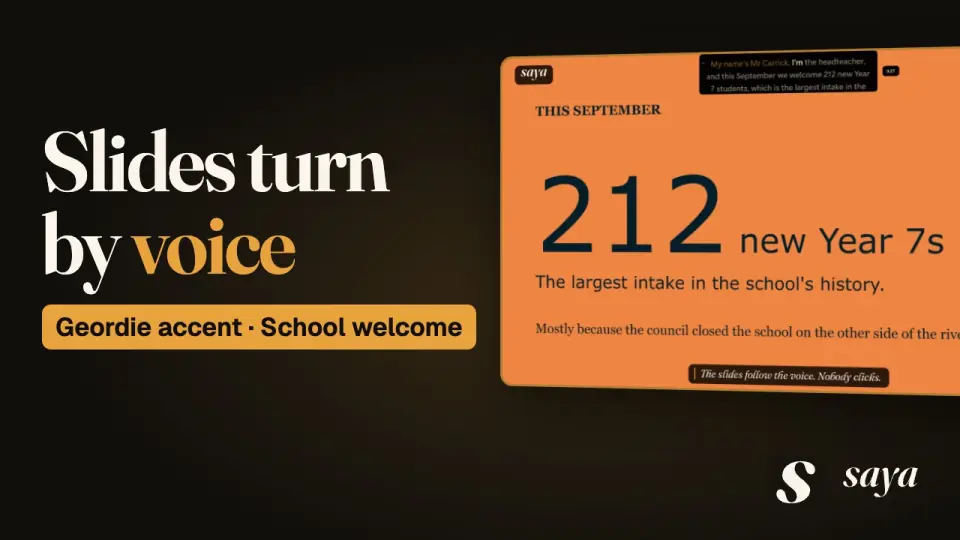 Geordie accent, with slides“Label the Labels” · 4:33
 Chinese accent, with slides“The Shelves Come to You” · 4:59
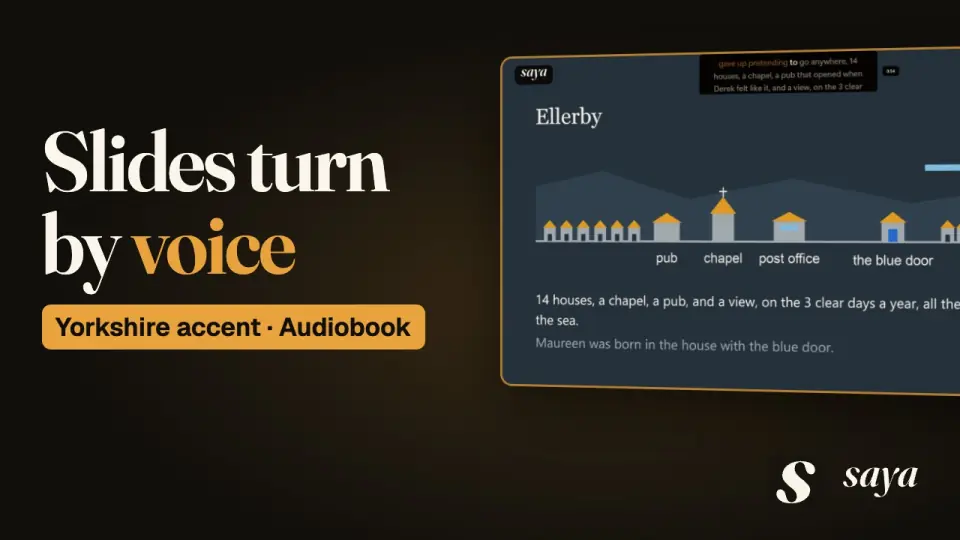 Yorkshire accent, with slides“We Shall See” · 4:24
 Swedish accent, with slides“Trees Do Not Read the News” · 5:00
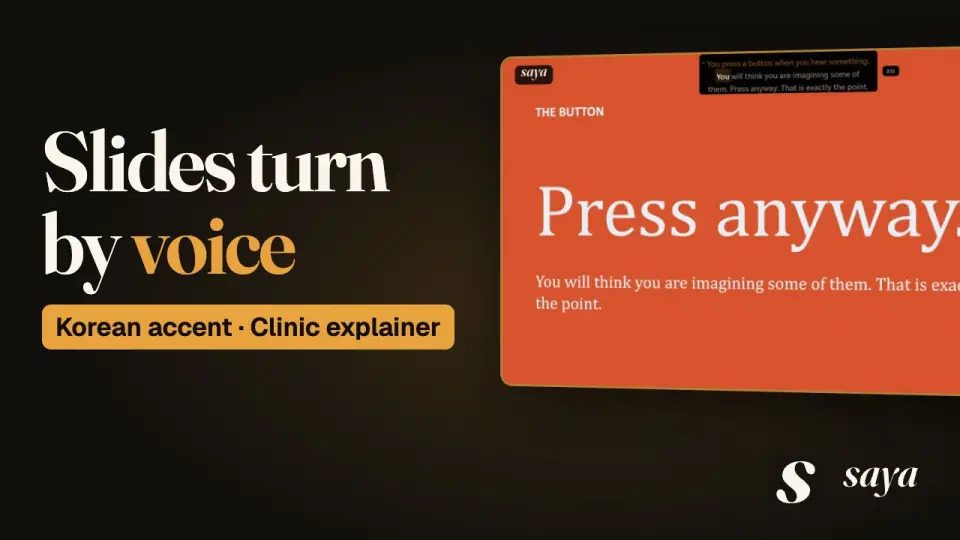 Korean accent, with slides“Press Anyway” · 5:06
 Filipino accent, with slides“Listen to the Pencil Marks” · 5:45