Slides That Follow Your Voice: Romanian Accent Pre Concert
Radu, conducting tonight, introduces the Third Symphony of Ilinca Vlad, finished in 1947, first played in 1951 and then not played again for 38 years. SAYA shows the slides full screen and turns them as the talk reaches them. Along the way the voice goes off script, corrects itself, restarts a sentence, pauses and skips a line.
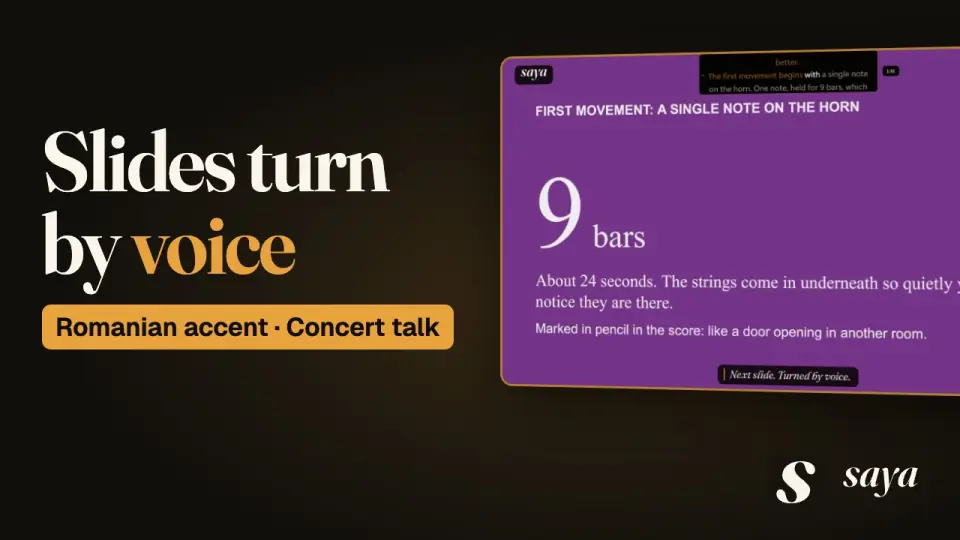
“One Note, Held for Nine Bars”, a scripted demo talk with slides on SAYA for Windows on a remote test server, in one take from start to finish, with opening and closing titles added. SAYA turns the slides as the talk reaches them. The voice reached SAYA through a virtual audio cable, not a room microphone. The accent name is the voice library's label.
Moments to watch
Select a time to play from there. A “…” marks where a quote starts or stops mid-sentence.
A slip and a fix0:19
These talks are optional, and there are usually about forty people, and tonight I count about two hundred, no, three hundred, which means either the heating is broken in the foyer or you have heard that the piece is difficult. It …
Off script0:34
No? It is both. Okay.
Said another way2:03
I have told him, if it cracks, people will remember, and if it does not, nobody will notice, and that this is a horn player's whole life, and he has made his peace with it. [chuckles] The second …
A pause3:29
Everything else in the piece is the world, and that viola is one person in it, and you are supposed to feel how small that is and how it carries on anyway, how it carries on anyway. I …
A skipped part4:07
Sorry, I skipped the phones. Phones off. Completely. Not silent. The first movement is quiet enough that a vibration in row twenty will reach me, and I shall know which row, and I shall look. Thank you. I …
Transcript
The words of the talk as the voice says them, including its asides and slips. The text on screen is the script. While the film plays, the current paragraph is marked.
Slide 1: One Note, Held for Nine Bars
0:17Good evening. Thank you for coming early. These talks are optional, and there are usually about forty people, and tonight I count about two hundred, no, three hundred, which means either the heating is broken in the foyer or you have heard that the piece is difficult. It is both. No? It is both. Okay.
Slide 2: Tonight: 300 of you
0:36My name is Radu, I am conducting tonight, and in twenty minutes I will walk out there and not speak again for an hour and a half, so this is my one uh... one chance to tell you what you are about to hear, and I am going to take it.
0:51The piece is the Third Symphony of Ilinca Vlad. She was born in nineteen oh two in a town on the Mureș, she wrote four symphonies, two operas that nobody performs, and sixty-one songs that everybody in this country learns at school without being told who wrote them. Sixty-three, my wife says, she counted. Sixty-one are in the schoolbook. Fine. The Third was finished in nineteen forty-seven and first played in nineteen fifty-one, and then not played again for thirty-eight years, for reasons that were not musical, and which I will not go into tonight, because she would not have.
Slide 3: Ilinca Vlad
1:25It is fifty-two minutes long, in three movements, and the third movement is the one people talk about, so let me tell you about the first two, which nobody talks about, and which I think are better.
Slide 5: 9 bars on the horn
1:37The first movement begins with a single note on the horn. One note, held for nine bars, which is about twenty-four seconds, and the strings come in underneath it so quietly that in most halls you cannot tell when they started, you only notice that they are there. She marked it, in the score, in pencil, like a door opening in another room. The horn player tonight is twenty-six. He has been practising that note for three weeks.
2:03I have told him, if it cracks, people will remember, and if it does not, nobody will notice, and that this is a horn player's whole life, and he has made his peace with it. [chuckles]
2:15The second, the dance, the second movement. The second movement is a dance that is not a dance. It is in seven, which means you cannot tap your foot to it, and I would ask you not to try, because I will see you. You are tapping. Sir. Yes. I can see you. It will not work. It is in seven. Okay. She took a village rhythm, the kind of thing her grandmother would have danced to, and she bent it, so that every time you think you have found the step, it has moved.
Slide 6: Second movement: 7 in the bar
2:45It is very hard to play. The orchestra hates it. The orchestra also, when we get it right, which has happened twice in rehearsal, goes silent afterwards in a way I have not seen with any other piece.
2:58The third movement you will have read about. It is loud, it is nineteen minutes, and there is a passage, about six minutes from the end, where the whole orchestra stops and a single viola plays alone for forty seconds. In nineteen fifty-one the audience thought it was a mistake. Some of them laughed. The viola player that night, we know from her diary, cried in the dressing room afterwards and did not come back for the second performance. [sighs]
Slide 7: Third movement: 40 seconds
3:26The passage is not a mistake. It is the point. Everything else in the piece is the world, and that viola is one person in it, and you are supposed to feel how small that is and how it carries on anyway, how it carries on anyway.
Slide 8: It is the point
3:44I wanted to say something about the viola player, what happened to her later, and, you understand, I have the notes here, and, no. It is a long story and it does not end the way you want. Another evening. Let us say that.
3:58I will stop. The orchestra is tuning, you can hear them, and the horn player is somewhere behind that curtain doing whatever horn players do. Sorry, I skipped the phones. Phones off. Completely. Not silent. The first movement is quiet enough that a vibration in row twenty will reach me, and I shall know which row, and I shall look.
Slide 9: Phones completely off
4:20Thank you. I will see you in there.
More demo films
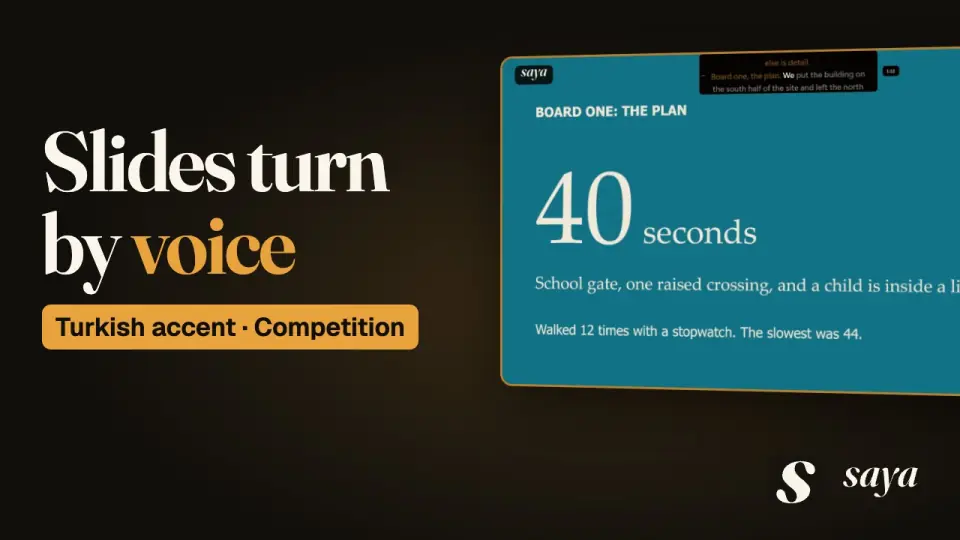 Turkish accent, with slides“The Tree and the Children” · 4:30
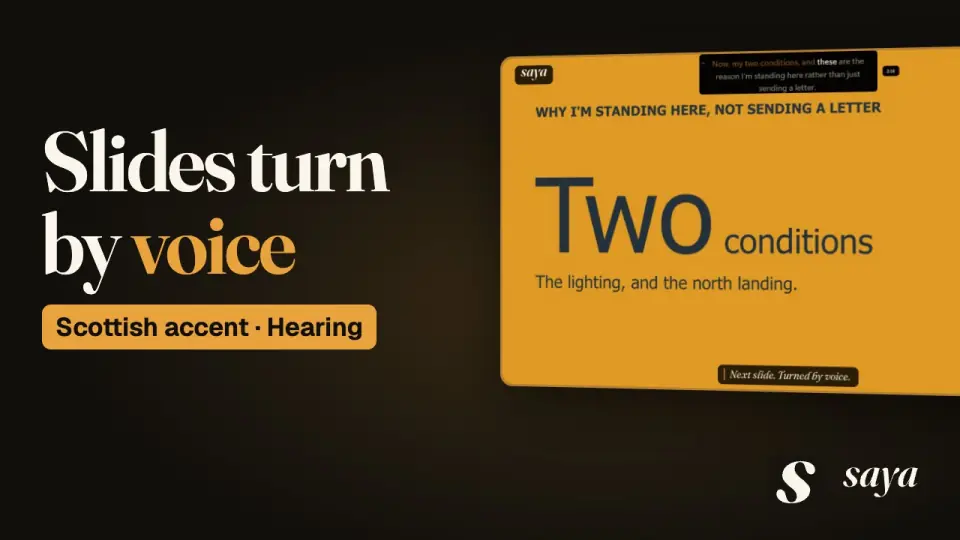 Scottish accent, with slides“Light the Path, Not the Sky” · 4:32
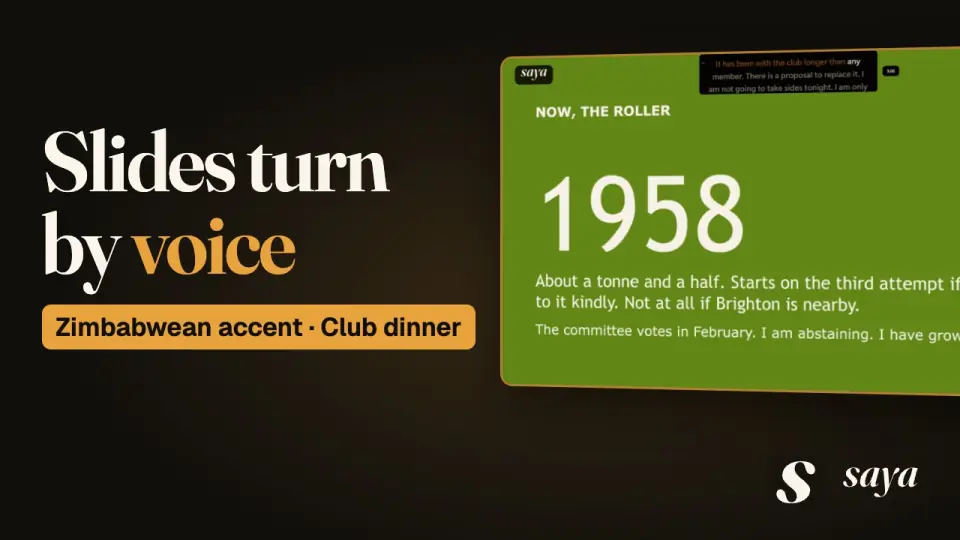 Zimbabwean accent, with slides“Younger Than the Roller” · 4:26
 Italian accent, with slides“Three Minutes, Then Disappear” · 5:10
 Polish accent, with slides“A Brick That Fixed Itself” · 5:43
 Indonesian accent, with slides“Thin First, Thick Last” · 4:59