Slides That Follow Your Voice: Polish Accent Thesis Defence
Tomasz defends a doctoral thesis on bacterial spores that heal early-age cracks in low-clinker concrete. SAYA shows the slides full screen and turns them as the talk reaches them. Along the way the voice goes off script, corrects itself, restarts a sentence, pauses and skips a line.
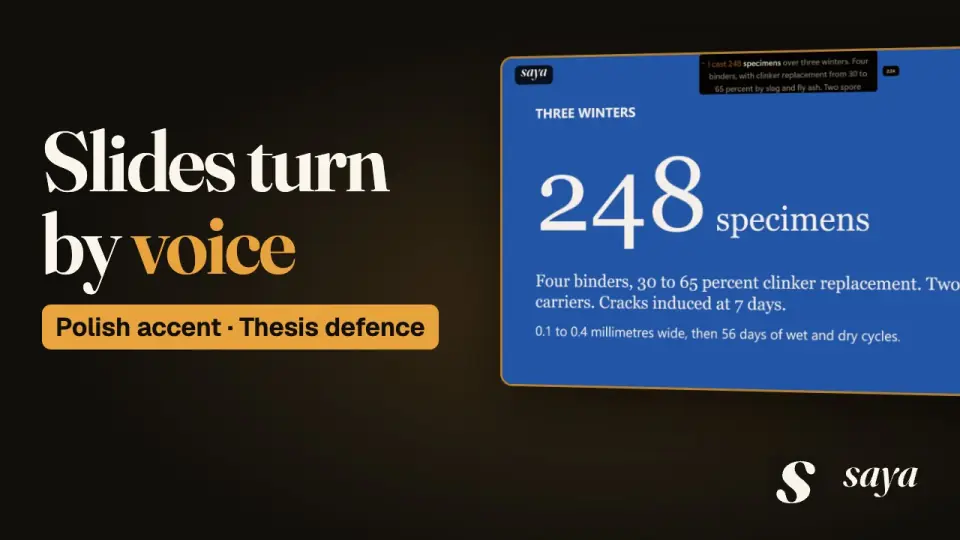
“A Brick That Fixed Itself”, a scripted demo talk with slides on SAYA for Windows on a remote test server, in one take from start to finish, with opening and closing titles added. SAYA turns the slides as the talk reaches them. The voice reached SAYA through a virtual audio cable, not a room microphone. The accent name is the voice library's label.
Moments to watch
Select a time to play from there. A “…” marks where a quote starts or stops mid-sentence.
Off script1:32
I say this because my supervisor told me, in my first week, that the quickest way to fail a defence is to claim you invented something the committee invented. Professor Hajduk, I have read your two thousand and …
A slip and a fix2:28
I cast two hundred and forty, sorry, two hundred and forty-eight specimens over three winters.
Said another way3:04
First, the healing does work in low-clinker concrete, only more slowly. At zero point two millimetres, the reference mix closed ninety-one percent of the crack area in twenty-eight days.
A pause4:02
I did not expect that, and I checked it twice, because I thought the instrument was wrong. What I cannot claim.
A skipped part4:13
My longest observation is fifty-six days, and a bridge is expected to last one hundred years. Those …
Transcript
The words of the talk as the voice says them, including its asides and slips. The text on screen is the script. While the film plays, the current paragraph is marked.
Slide 1: Self-healing concrete
0:17Honoured committee, Professor Wierzbicka, Professor Hajduk, members of the audience, my mother. [chuckles] Thank you for coming. My name is Tomasz, and for the next twenty minutes I will defend a thesis with the title, Spore-based self-healing of early-age cracks in low-clinker concrete, which is a long title, and I uh, apologise to whoever has to read it out at the end. [laughs]
0:42So, let me begin with the problem, because it is simple and it is expensive. Concrete cracks. It cracks early, in the first days, from shrinkage and heat, and the cracks are small, usually under zero point three millimetres.
Slide 2: The problem: 0.3 millimetres
0:59A crack of that size does not threaten the structure. It threatens the steel inside, because water and chlorides enter through the crack, the reinforcement rusts, and twenty years later the repair costs more than the bridge did. In this country we spend, by the ministry's own estimate, about one point two billion zloty a year on this kind of repair. I do not know if that number is exact. It is the ministry's number.
1:27The idea I have worked on is not mine, and I want to say that clearly. I say this because my supervisor told me, in my first week, that the quickest way to fail a defence is to claim you invented something the committee invented. Professor Hajduk, I have read your two thousand and eleven paper. Several times. Also at night. So. Next slide. No, sorry, back one. Yes.
Slide 3: The idea is not mine
1:54Since the early two thousands, researchers have added bacterial spores to concrete, together with a nutrient, so that when a crack opens and water enters, the spores germinate, consume the nutrient, and um, precipitate calcium carbonate, which fills the crack. It works in the laboratory. The question of my thesis is narrower: does it work in the low-clinker concretes we are now required to use, which have a different chemistry, a lower alkalinity, and a much slower early strength?
2:28I cast two hundred and forty, sorry, two hundred and forty-eight specimens over three winters. Four, the binders, four... Four binders, with clinker replacement from thirty to sixty-five percent by slag and fly ash. Two spore carriers, expanded clay and a coated granule that we developed with the ceramics department. Cracks were induced at seven days, to widths between zero point one and zero point four millimetres, and the specimens were cycled, wet and dry, for fifty-six days.
Slide 4: 248 specimens
3:02Three findings. First, the healing does work in low-clinker concrete, only more slowly. At zero point two millimetres, the reference mix closed ninety-one percent of the crack area in twenty-eight days. The sixty-five percent slag mix needed forty-nine days to reach the same value.
Slide 5: First: it works, but slower
3:23Second, the carrier matters more than the binder. The coated granule released spores only when the crack passed through it, and survival after mixing was seventy-four percent, against thirty-one percent for expanded clay.
Slide 6: Second: the carrier matters
3:39Third, and this was not expected, water permeability recovered before the crack looked closed. By day twenty-one, the permeability of healed specimens was within eight percent of uncracked concrete, while the surface still showed a visible line. So the crack heals from the inside out, from the inside out. I did not expect that, and I checked it twice, because I thought the instrument was wrong.
Slide 7: Third: healing from the inside out
4:09What I cannot claim. I did not test freeze-thaw. My longest observation is fifty-six days, and a bridge is expected to last one hundred years.
Slide 8: What I cannot claim
4:20Those are the next three theses, and I hope somebody else writes them. [chuckles] Preferably somebody with a stronger back. Each specimen is eleven kilograms, there were two hundred and forty-eight of them, the laboratory is on the third floor, and the lift has been, how is it called, out of order, since my second year. I mention this for the record. The record does not care. Anyway.
4:47One more thing, if the committee permits. In the third winter, specimen one hundred and eighty-four cracked in a way I had not induced, along a corner, probably from a flaw in the mould. I almost threw it away. [sighs] My mother has seen it. She said it looks like a brick. It does look like a brick. I had no good answer to that, and I still have none, so.
Slide 9: Specimen 184: 34 days
5:13I did not, and it healed completely, in thirty-four days, with no help from me, which I think is the whole point of the method. I kept it. It is on the table by the door, if you would like to see it after the questions.
5:28Thank you. I am ready for your questions, and I have been for about three years. [laughs]
More demo films
 Indonesian accent, with slides“Thin First, Thick Last” · 4:59
 Cockney accent, with slides“It Is the Somebody” · 4:43
 Danish accent, with slides“Forty Minutes on the Bicycle Shed” · 5:46
 Ukrainian accent, with slides“Verba Blue” · 4:53
 Tamil accent, with slides“Show Your Working” · 4:27
 Indian accent, with slides“Where the Slack Goes” · 4:45