Slides That Follow Your Voice: British Accent Council Report
An estuary trust's year-three report to a town council: three reef sites, a white disc that shows the water getting clearer month by month, a storm that took a third of one site, what it cost and what comes next. SAYA shows the slides full screen and turns them as the talk reaches them. Along the way the voice goes off script, corrects itself, restarts a sentence, pauses and skips a line.
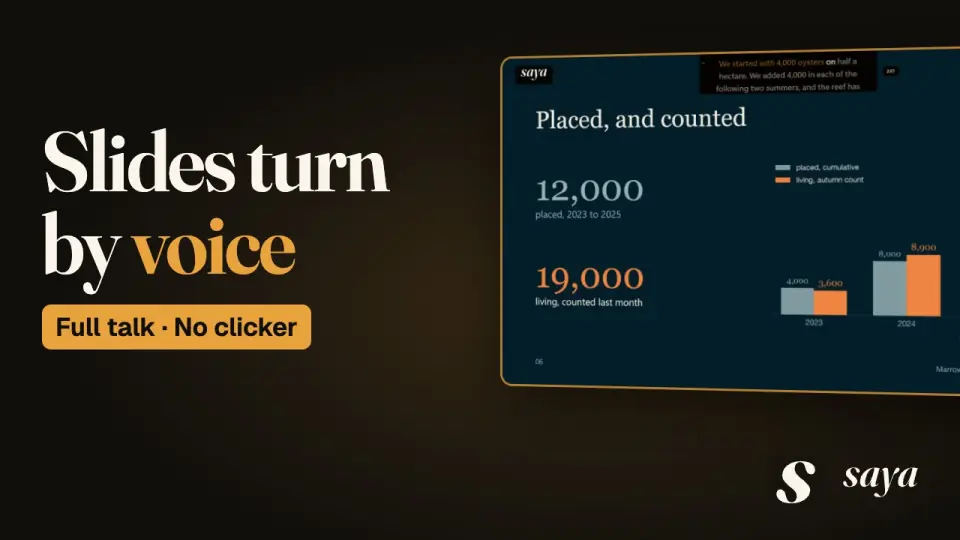
“What Twelve Thousand Oysters Did”, a scripted demo talk with slides on SAYA for Windows on a remote test server, in one take from start to finish, with opening and closing titles added. SAYA turns the slides as the talk reaches them. The voice reached SAYA through a virtual audio cable, not a room microphone. The accent name is the voice library's label.
Moments to watch
Select a time to play from there. A “…” marks where a quote starts or stops mid-sentence.
Off script0:28
some of you were here, you remember,
Said another way1:00
That is one point four hectares all together. Two football pitches, roughly, if that helps anyone. In the spring of twenty twenty-two we lowered a white disc into the water at the slipway and watched it disappear. It …
A pause1:16
You could not see your own hand at the elbow. That …
A slip and a fix2:15
A bit under half, actually, if you measure it properly. We added four thousand in each of the following two summers, and the reef has grown with them, because the young ones settle on the shells of the old ones. Twelve …
A skipped part2:35
It was done by three hundred and seventeen volunteers who gave four thousand one hundred hours, most of them before seven in the morning, because that is when the tide is out.
Transcript
The words of the talk as the voice says them, including its asides and slips. The text on screen is the script. While the film plays, the current paragraph is marked.
Slide 1: What twelve thousand oysters did
0:17Good evening, everyone. Thank you for having us back. Three years ago this council gave a small trust a permit, a tide table and, and, I think it is fair to say, some of you were here, you remember, not much confidence. Tonight I want to show you what twelve thousand oysters did with it.
0:37This is the Marrowby estuary as it looks from above. That is the new drawing, by the way. Hamid redrew it over the summer. The old one had the bridge on the wrong side of the river, which nobody noticed for two years, including me. The three reef sites are the orange marks: A by the old slipway, B under the railway bridge, and C out on the Hollin flats. That is one point four hectares all together. Two football pitches, roughly, if that helps anyone.
Slide 2: Three sites, 1.4 hectares
1:06In the spring of twenty twenty-two we lowered a white disc into the water at the slipway and watched it disappear. It disappeared at forty centimetres. Forty.
Slide 3: Where we started
1:19You could not see your own hand at the elbow. That is where we started.
1:25One oyster, on a good day, passes about a hundred and fifty litres of water through itself. It takes the, sorry, It takes out the silt and the algae and it leaves the water behind it clearer. It does not do this for us. It does it because that is how it eats. We just put a lot of them in the same place.
Slide 4: What one oyster does
1:46Here is the disc again, every month since. By the end of year one the slipway was at sixty-five centimetres. Year two, ninety. This October we measured a hundred and ten.
Slide 5: The disc, every month since
2:01Yes. You are allowed to be pleased about that. I was. The flats are slower, because the water moves more out there, but they are moving the same way.
2:11We started with four thousand oysters on half a hectare. A bit under half, actually, if you measure it properly. We added four thousand in each of the following two summers, and the reef has grown with them, because the young ones settle on the shells of the old ones. Twelve thousand placed, and by our count last month, closer to nineteen thousand alive.
Slide 6: Placed, and counted
2:33None of this was done by the trust. It was done by three hundred and seventeen volunteers who gave four thousand one hundred hours, most of them before seven in the morning, because that is when the tide is out. I will say one name, because she is not here. She is in hospital with a new hip, and she asked me to say that she will be back for the September count. Margaret has done every single Saturday since the first one. Every one. Through the storm winter as well. We have tried to make her stop, and we have not managed it, and I do not think the council would manage it either. Forty of them are in this room.
Slide 7: Who did it
3:10The whole programme, three years, cost a hundred and twelve thousand pounds, hundred and twelve thousand pounds. Dredging the same channel once, which is what the harbour board quoted in twenty twenty-one, would have cost two hundred and forty thousand, and we would be back here asking to do it again in five years.
Slide 8: What it cost
3:31Our monthly survey in twenty twenty-two found nine species along the slipway wall. This autumn it found twenty-three. Juvenile sea bass, which nobody has recorded in the inner estuary since the eighties. Eels. A great many shore crabs, which the children count They bite, apparently. I have not tested this. for us and which I am told are very annoying to count.
Slide 10: February 2024
3:56Now the part that did not go well. In February twenty twenty-four a storm took the eastern third of site B, the one under the bridge. The cages were, we had rated the cages, The cages were rated for the wave height we had seen in the records. The storm did not read the records. We re-laid it in May with heavier frames, and it has held since, but I want you to see it, because it is in the numbers you have already seen.
4:23So here is what we are asking for. First, a permit for a fourth site, D, on the north bank. Second, forty-eight thousand pounds for year four, which is less than year three because the frames are already paid for. And third, the slipway repaired, so the volunteers stop carrying cages over the rocks.
Slide 11: Year four
4:44That is the report. If you want to see it rather than hear about it, we are on the slipway this Saturday at twenty to eight in the morning. Low tide is at eight. Bring boots. Thank you.
More demo films
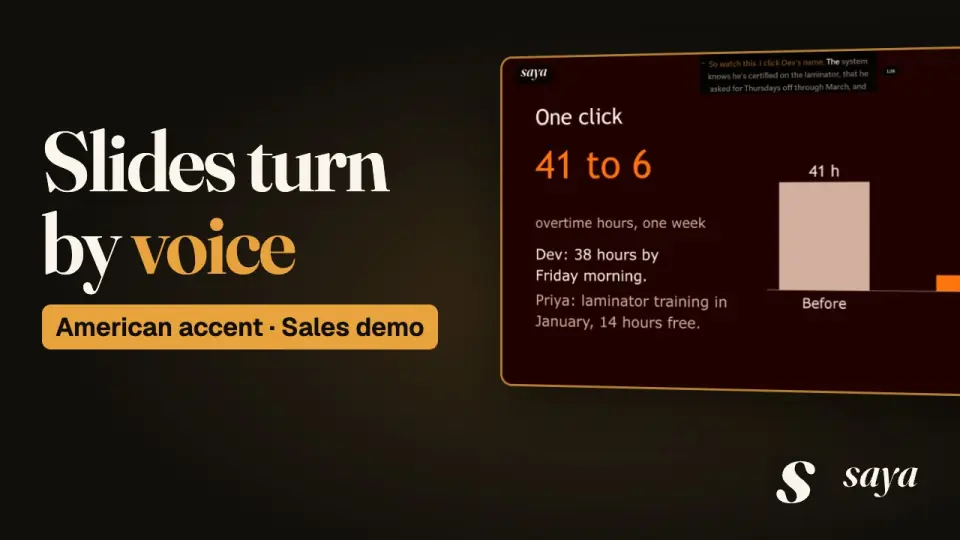 American accent, with slides“Two Stores, Thirty Days” · 4:53
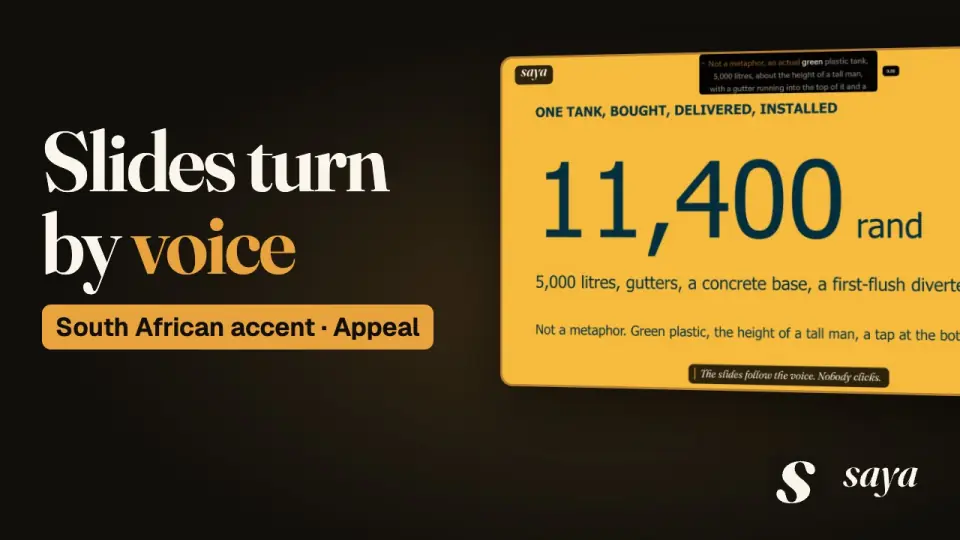 South African accent, with slides“Clean Water In, Honest Numbers Out” · 5:34
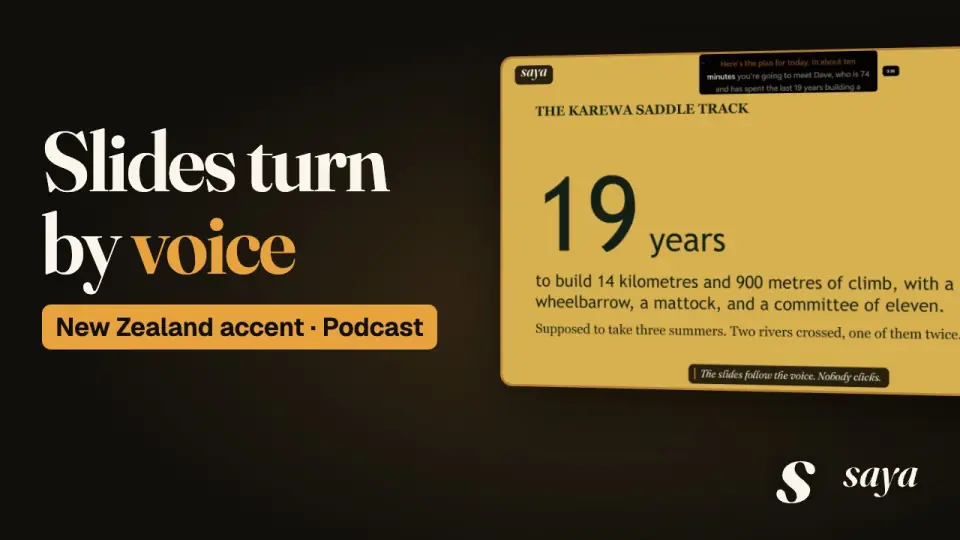 New Zealand accent, with slides“It Was There the Whole Time” · 4:48
 Dutch accent, with slides“A Lake That Did Nothing for Forty Years” · 5:08
 Russian accent, with slides“People with Old Telescopes” · 5:08
 Arabic accent, with slides“Angry Tonight, Not Surprised in March” · 4:56