Slides That Follow Your Voice: Russian Accent Conference Keynote
An astronomer on space debris, from an estimated 1 million fragments too small to track, to the cascade, to why radar is nearly blind above 2,000 kilometres, and how four old telescopes found 1,340 objects that were in nobody's catalogue. SAYA shows the slides full screen and turns them as the talk reaches them. Along the way the voice goes off script, corrects itself, restarts a sentence, pauses and skips a line.
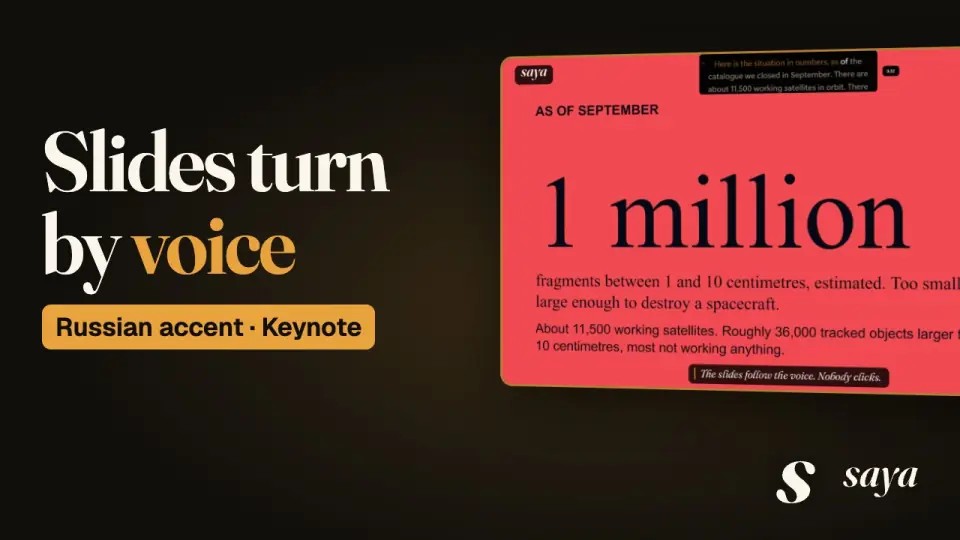
“People with Old Telescopes”, a scripted demo talk with slides on SAYA for Windows on a remote test server, in one take from start to finish, with opening and closing titles added. SAYA turns the slides as the talk reaches them. The voice reached SAYA through a virtual audio cable, not a room microphone. The accent name is the voice library's label.
Moments to watch
Select a time to play from there. A “…” marks where a quote starts or stops mid-sentence.
A slip and a fix0:41
There are about eleven thousand, eleven and a half thousand working satellites in orbit. There …
A pause1:34
There is a threshold density beyond which this process runs by itself, and the honest answer to where we are relative to that threshold is that we do not know, do not know precisely, and that is itself …
Off script1:50
I want to add something here about the models, because there are three of them and they, no. No, it does not matter for today. Ask me in the break if you like models.
Said another way2:41
We call it Vysota. It cost one point eight million in our currency, which is less than one mid-size satellite insurance premium. I know this because I asked an insurer, at a conference like this one, and he …
A skipped part3:38
In March twenty twenty-three we found an object on a trajectory that would pass within four hundred metres of an active satellite. We …
Transcript
The words of the talk as the voice says them, including its asides and slips. The text on screen is the script. While the film plays, the current paragraph is marked.
Slide 1: People with old telescopes
0:17Good morning. I am an astronomer, which means that for most of my career I have looked up and tried to ignore everything closer than the Moon. [chuckles] Ten years ago that became impossible, and I want to spend my twenty-five minutes explaining why, and what a small team with old telescopes decided to do about it.
0:36Here is the situation in numbers, as of the catalogue we closed in September. There are about eleven thousand, eleven and a half thousand working satellites in orbit. There are roughly thirty-six thousand tracked objects larger than ten centimetres, most of which are not working anything, and an uh... an estimated one million fragments between one and ten centimetres, which are too small to track and large enough to destroy a spacecraft.
Slide 2: 1 million fragments
1:04At orbital velocities, a fragment the size of a coin carries the energy of a car at motorway speed. The ten-centimetre ones carry, let us say, the energy of a small bomb. These numbers are of course estimates. Everyone's are.
Slide 3: A coin at highway speed
1:19The danger is not any single piece. It is the cascade. Every collision produces thousands of new fragments, each of which can cause a new collision, and above about eight hundred kilometres the atmosphere is too thin to clean anything up for centuries.
Slide 4: The cascade
1:34There is a threshold density beyond which this process runs by itself, and the honest answer to where we are relative to that threshold is that we do not know, do not know precisely, and that is itself the problem.
1:50I want to add something here about the models, because there are three of them and they, no. No, it does not matter for today. Ask me in the break if you like models.
2:00Because here is the thing about the catalogue I just quoted. It is built almost entirely from radar, and radar is excellent at low orbits and nearly blind above two thousand kilometres. For the geostationary belt, at thirty-six thousand kilometres, where the communication satellites live, we rely on optical telescopes, and until recently we relied on very few of them.
Slide 5: Radar sees low, not high
2:23So, in twenty seventeen, my institute took four telescopes of fifty centimetres aperture, built in nineteen seventy-nine for a survey that ended in nineteen ninety-one, and converted them into a debris tracking array. We named it, we call, we call it... We call it Vysota.
Slide 6: Vysota: 4 old telescopes
2:42It cost one point eight million in our currency, which is less than one mid-size satellite insurance premium. I know this because I asked an insurer, at a conference like this one, and he told me the number, and then asked me not to repeat it, and I have repeated it at every conference since. He does not come to conferences now. That was a joke. Partly.
3:04Each telescope can see an object of thirty centimetres at geostationary distance, which is roughly a football, seen from a city away, moving. We take four thousand images a night. A pipeline I am very proud of, and which was written largely by two graduate students who have since left for better salaries, detects every streak, fits an orbit, and compares it to the catalogue.
3:28In seven years we have found one thousand three hundred and forty objects that were in nobody's catalogue. Most are fragments from two old break-ups.
Slide 7: 1,340 objects in nobody's catalogue
3:38In March twenty twenty-three we found an object on a trajectory that would pass within four hundred metres of an active satellite. We reported it, the operator moved the satellite by two kilometres, and nothing happened, which is the best possible outcome and the one that never makes the news. [sighs] The operator sent us a box of chocolates. One box. For four telescopes, two students and a satellite worth three hundred million. I am not complaining. They were good chocolates. I ate most of them myself, which the students have not forgotten. [laughs]
4:13I will close with a proposal, and it is modest. There are hundreds of telescopes of this size around the world, in universities, in clubs, on hills, built for surveys that have ended. Each one could do what ours does for the price of a camera and some software we will give away.
Slide 8: The sky above 2,000 km is not watched
4:30The sky above two thousand kilometres is not watched. It should be. It does not need a new space agency. It needs people with old telescopes and a reason, and I think that is all I have to say. I was one of those people, at fourteen, with a telescope my father built from a drainpipe. Nobody told me it mattered. It did. That is, I think, the whole proposal, and I have said it badly, but there it is.
4:59Thank you.
More demo films
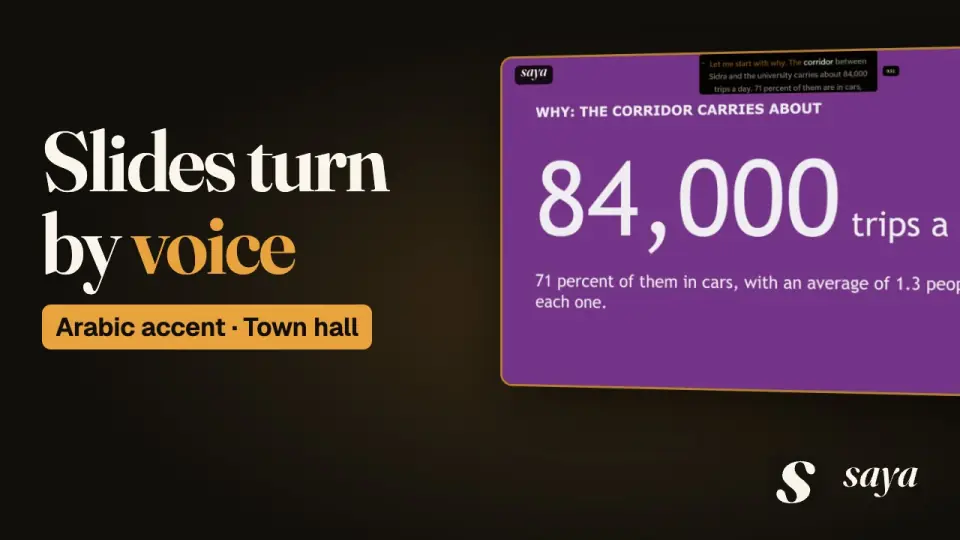 Arabic accent, with slides“Angry Tonight, Not Surprised in March” · 4:56
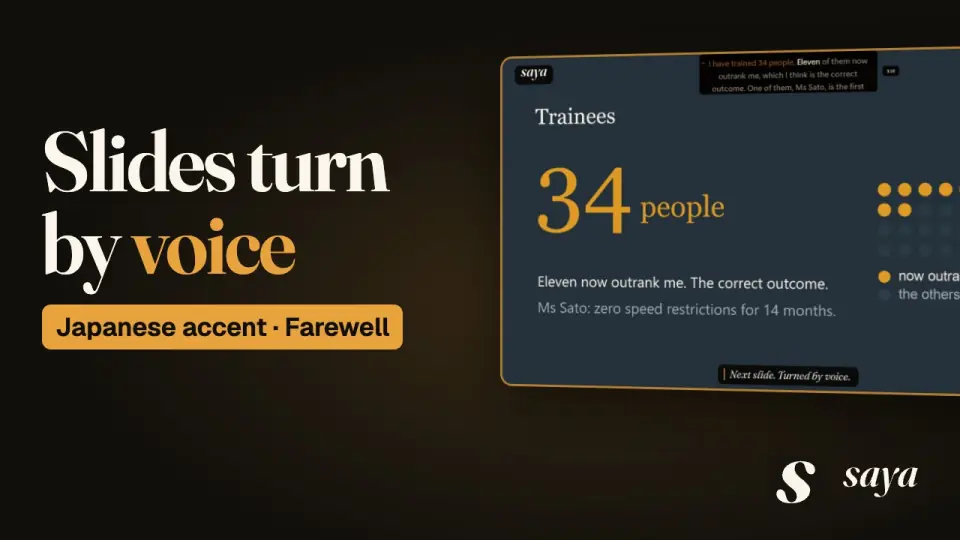 Japanese accent, with slides“Walk the Track at Night” · 5:00
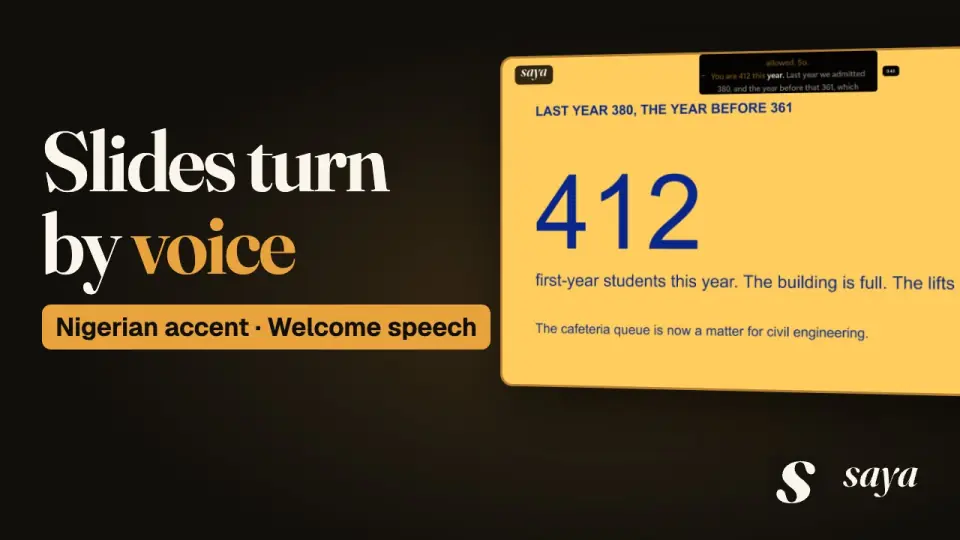 Nigerian accent, with slides“The Bridge Does Not Care” · 4:37
 Canadian accent, with slides“The Square Root of Winter” · 5:08
 French accent, with slides“I Am Not Brave, I Am on a Schedule” · 4:22
 British accent, with slides“Lamp Trimmed, All Well” · 5:01