Slides That Follow Your Voice: Canadian Accent Online Lecture
Lecture 7 of a physical limnology course: why ice floats, why the next 10 centimetres of ice take four times as long as the first, black ice and white ice on Lake Tamsin, the sound of a whole sheet cracking, and an assignment with real station data. SAYA shows the slides full screen and turns them as the talk reaches them. Along the way the voice goes off script, corrects itself, restarts a sentence, pauses and skips a line.
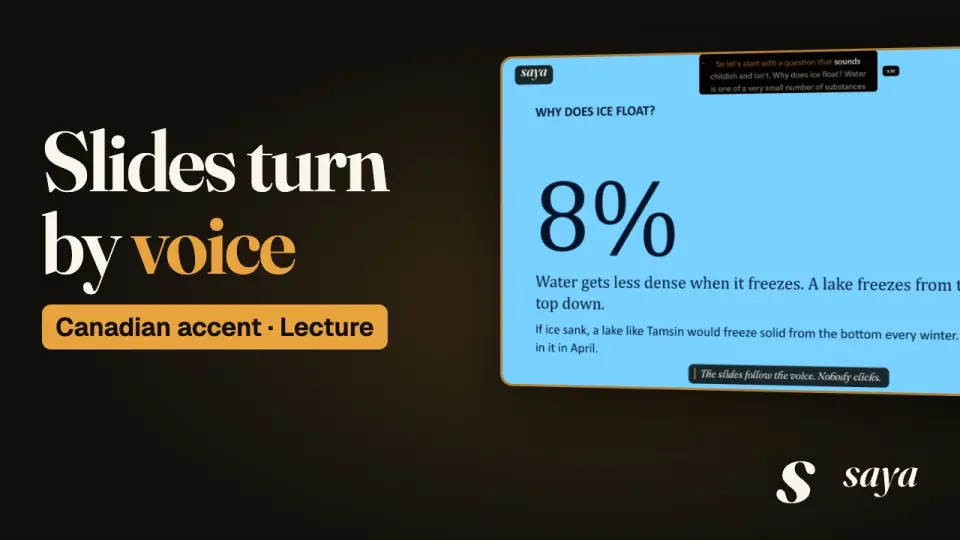
“The Square Root of Winter”, a scripted demo talk with slides on SAYA for Windows on a remote test server, in one take from start to finish, with opening and closing titles added. SAYA turns the slides as the talk reaches them. The voice reached SAYA through a virtual audio cable, not a room microphone. The accent name is the voice library's label.
Moments to watch
Select a time to play from there. A “…” marks where a quote starts or stops mid-sentence.
A pause0:38
Why does ice float? Water is one of a very small number of uh, substances that gets less dense when it freezes. Liquid …
Off script1:14
Which I used to find comforting as a kid and now find kind of threatening, because the whole thing rests on one anomaly in one molecule. Anyway. Priya's asking in the chat whether that's on the midterm. Yes. …
A slip and a fix1:35
There's an old result, from the eighteen eighties, no, nineties, that says the thickness of the ice is proportional to the square root of the accumulated freezing degree days. Not …
Said another way4:25
How thick the ice has to be before you walk on it, that's for whoever's responsible for that lake, not for me, and I'm not giving you a number. I say this every year and every year somebody …
A skipped part4:50
Growth slows as it goes.
Transcript
The words of the talk as the voice says them, including its asides and slips. The text on screen is the script. While the film plays, the current paragraph is marked.
Slide 1: Lake ice
0:17Okay, recording's on, welcome back to Physical Limnology, lecture seven. Today is lake ice. If you're watching this at double speed at two in the morning the night before the midterm, hi, I see you, and I've made the slides bigger on purpose. [chuckles]
0:34So let's start with a question that sounds childish and isn't. Why does ice float?
Slide 2: Why does ice float? 8%
0:43Water is one of a very small number of uh, substances that gets less dense when it freezes. Liquid water at four degrees Celsius has a density of about one thousand kilograms per cubic metre, and ice sits at nine hundred and seventeen.
0:59That eight percent difference is why a lake freezes from the top down, and it's also why there are fish in it in April. If ice sank, a lake like Tamsin would freeze solid from the bottom every winter and nothing bigger than a bacterium would live in it. Which I used to find comforting as a kid and now find kind of threatening, because the whole thing rests on one anomaly in one molecule. Anyway. Priya's asking in the chat whether that's on the midterm. Yes. Sort of. Not the threatening part. [laughs]
1:32Okay so, how fast does it grow? There's an old result, from the eighteen eighties, no, nineties, that says the thickness of the ice is proportional to the square root of the accumulated freezing degree days. Not the time, the square root.
1:49So the first ten centimetres come quickly, in a few cold nights, and the next ten take four times as long, because the ice itself is now insulating the water underneath it. Every centimetre you add, Every centimetre you add makes the next centimetre harder to make. I find that an unusually honest piece of physics, and I don't have a better way to say it.
Slide 3: The square root of winter
2:11Here's the complication, and it's the one that fills my um... inbox every January. Snow. A layer of twenty centimetres of fresh snow on top of the ice has roughly the insulating value of a cheap sleeping bag, so underneath it, growth pretty much stops.
Slide 4: Snow on the ice: Lake Tamsin
2:30But the snow, the, okay, let me start that again. But the weight of that snow pushes the ice sheet down, lake water floods up through cracks, soaks the snow, and refreezes into what we call white ice. White ice is full of air bubbles, it's less strong, and it's a very different material from the clear black ice that grew from below.
2:52On Lake Tamsin last February we measured thirty-one centimetres of ice in total, of which only fourteen were black. I had a diagram for this. It's not loading. Picture a lake. [sighs]
3:06Let me say something about sound, because people ask. When the air temperature drops quickly at night, the top of the ice sheet contracts faster than the bottom and the whole sheet cracks under tension. The sound you hear, that long descending whoop, is the crack travelling through a plate that's what's the word, uh, dispersive, which means the high frequencies arrive before the low ones. Students send me recordings of this every winter, usually at three in the morning, with the caption, is the lake okay. The lake is okay. The lake's doing exactly what the lake does. You should go to sleep. I should also go to sleep, honestly, but.
Slides 5-6: The whole sheet cracks under tension / The ice isn't breaking. It's adjusting.
3:46That's why it sounds like a science fiction laser and not like a snap. [laughs]
3:52The ice isn't breaking, it's adjusting, and it does this on the coldest, most stable nights of the year.
3:59For the assignment, I've posted temperature data from the Tamsin station for the winter of twenty twenty-two to twenty twenty-three. I want you to compute freezing degree days, uh, predict the ice thickness for every Friday, and then compare it to the eleven real measurements in the second file.
Slide 7: Tamsin station, winter 2022 to 2023
4:16Your prediction will be too high. I want you to tell me why, in one paragraph, not a page.
4:24One more thing. How thick the ice has to be before you walk on it, that's for whoever's responsible for that lake, not for me, and I'm not giving you a number. I say this every year and every year somebody emails me a photo of themselves on the ice with the caption, looks fine. I'm a physicist. I'm not your mother. I'm also not about to pretend I don't think about that photo. Okay. Anyway. Where were we.
Slide 8: The ice you can see is not necessarily the ice that holds you
4:50Growth slows as it goes. The ice you can see is not necessarily the ice that holds you.
4:58See you Thursday.
More demo films
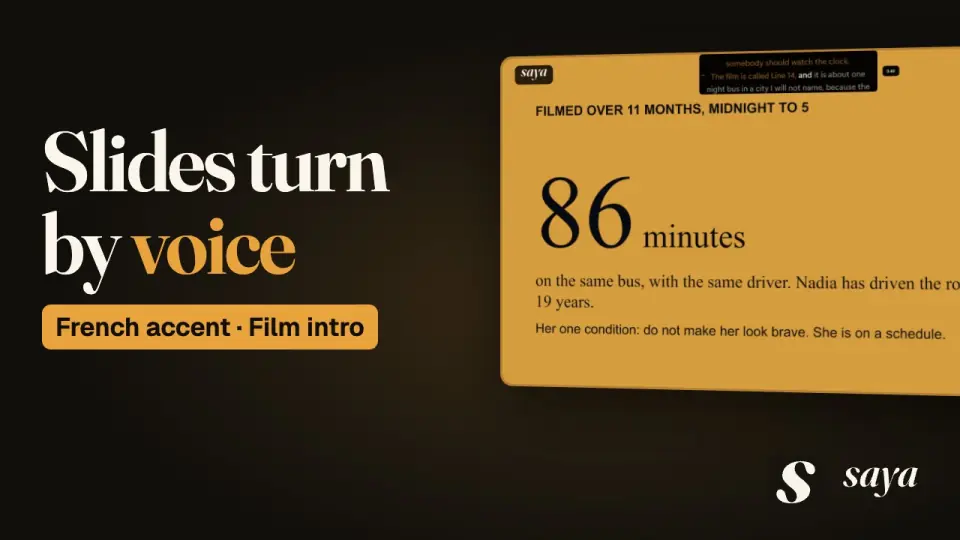 French accent, with slides“I Am Not Brave, I Am on a Schedule” · 4:22
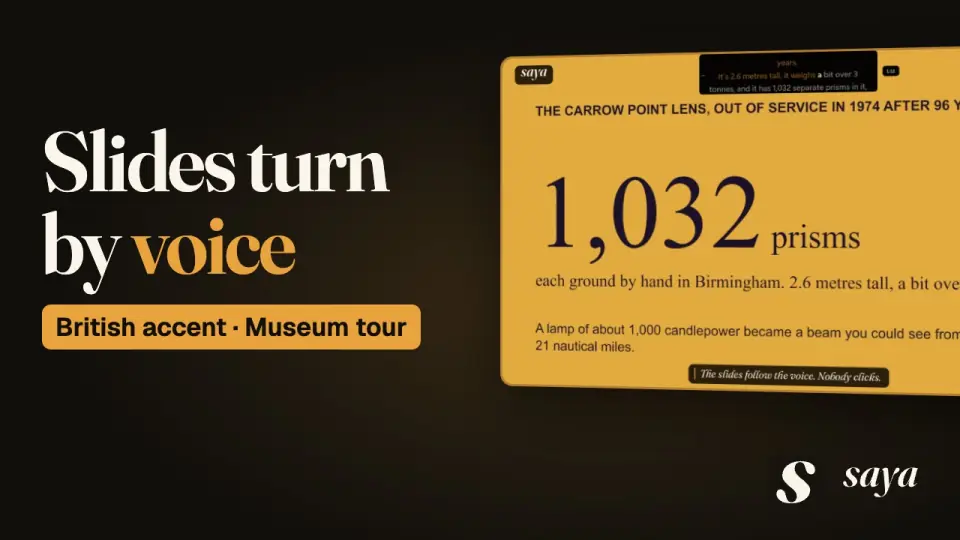 British accent, with slides“Lamp Trimmed, All Well” · 5:01
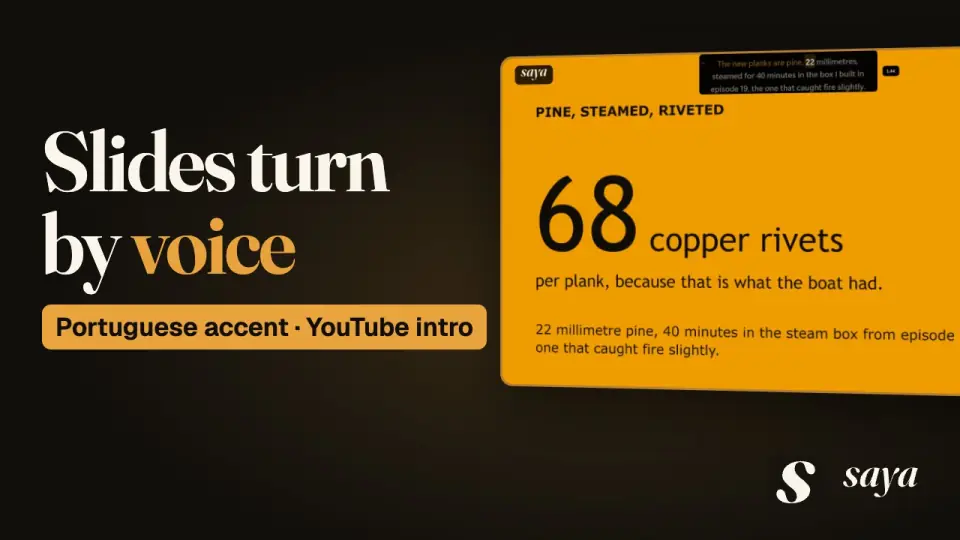 Portuguese accent, with slides“More Boat Than Hole” · 4:21
 Irish accent, with slides“The Girl in the Shed” · 4:27
 Jamaican accent, with slides“A Shell and Not a Prayer” · 4:55
 Australian accent, with slides“One Microwave, Retired with Honours” · 4:27