Slides That Follow Your Voice: Indian Accent Ideas
A timetable planner has spent 14 years on one suburban line, 23 stations and 41 kilometres, where a train 5 seconds late leaves the whole line 2 minutes late by the seventh train. SAYA shows the slides full screen and turns them as the talk reaches them. Along the way the voice goes off script, corrects itself, restarts a sentence, pauses and skips a line.
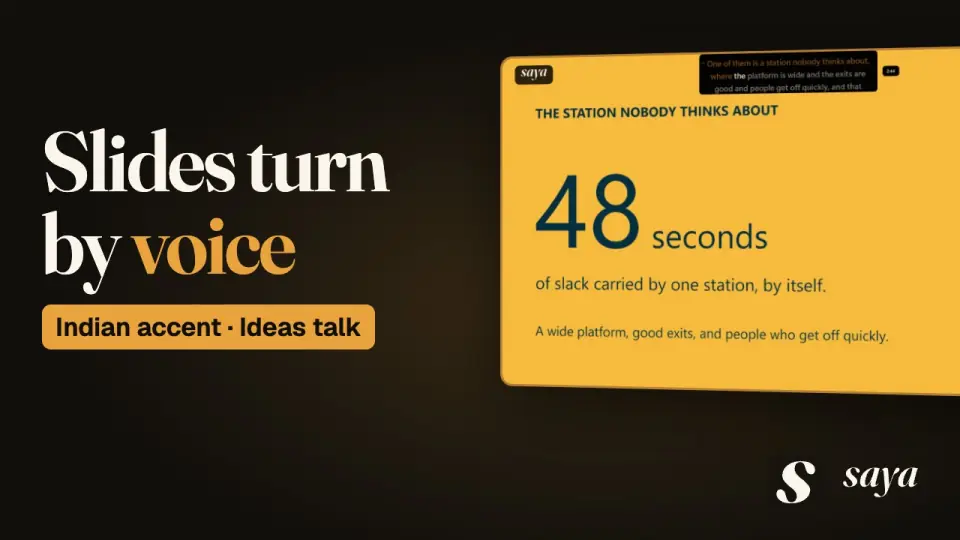
“Where the Slack Goes”, a scripted demo talk with slides on SAYA for Windows on a remote test server, in one take from start to finish, with opening and closing titles added. SAYA turns the slides as the talk reaches them. The voice reached SAYA through a virtual audio cable, not a room microphone. The accent name is the voice library's label.
Moments to watch
Select a time to play from there. A “…” marks where a quote starts or stops mid-sentence.
A slip and a fix0:58
But the train behind it must now wait at the signal, and the one behind that, and by the fourth train the gap is thirty, no, forty seconds, and the platform at the big junction has forty seconds …
A pause1:17
One person held a door for a friend, a door for a friend. This is called bunching, and every city with a busy line has it, and the usual answer is to add slack.
Off script1:54
The clicker is not working. Okay. It is fine, there is nothing on the slide anyway, it is a picture of a train, you have seen a train. Where was I. Slack. Where it goes.
Said another way3:40
When something is running late, everybody wants to spread the fix around, a little patience in every place. It does not work.
A skipped part3:58
[sighs] My wife is a doctor, and when I told her this at dinner she said, yes, we call it triage, we have had it for a hundred years, kindly pass the dal. So. I am not the …
Transcript
The words of the talk as the voice says them, including its asides and slips. The text on screen is the script. While the film plays, the current paragraph is marked.
Slide 1: Where the Slack Goes
0:17Good evening. I want to talk about a timetable. Not a famous one, not a fast train, just the suburban timetable for one line in one city, which I have worked on for fourteen years, and which I think is the most interesting mathematical object most of you have ever held in your hand without noticing.
0:35Here is the problem, basically. One line, twenty-three stations, forty-one kilometres. In the morning peak we run a train every three minutes and twenty seconds. Each train carries about three thousand people, officially. [chuckles]
Slide 3: Five seconds becomes two minutes
0:50A train that stops at a station for thirty seconds instead of twenty-five is late by five seconds. That does not sound like anything. But the train behind it must now wait at the signal, and the one behind that, and by the fourth train the gap is thirty, no, forty seconds, and the platform at the big junction has forty seconds more of people on it. By the seventh train the whole line is running two minutes late, and nobody did anything wrong. One person held a door for a friend, a door for a friend.
Slides 4-5: One person held a door for a friend / Bunching, and the usual answer
1:24This is called bunching, and every city with a busy line has it, and the usual answer is to add slack. Give every stop thirty-five seconds instead of twenty-five, and then a small delay is absorbed. But slack costs capacity. If I add ten seconds at every one of twenty-three stations, I have added almost four minutes to the journey, and I have lost about one train an hour, which is three thousand people uh... standing on a platform at eight forty looking at me.
1:54The clicker is not working. Okay. It is fine, there is nothing on the slide anyway, it is a picture of a train, you have seen a train. Where was I. Slack. Where it goes.
2:07Basically, the thing, what I have been chasing, basically... So the question I have spent fourteen years on is: where does the slack go? Not how much, where. And it turns out the answer is not even. The answer is that you put most of it at three or four stations, and almost none anywhere else.
Slide 7: 2.1 million train stops
2:26We found those stations by looking at six years of data, about two point one million train stops, two point one, I checked this morning, it is two point one, and asking a simple question of each one: when a train arrived here late, did it leave less late? The stations where the answer was yes, reliably, are the recovery points. There are four of them on my line. One of them is a station nobody thinks about, where the platform is wide and the exits are good and people get off quickly, and that station is now carrying forty-eight seconds of slack by itself.
Slide 9: Lateness: 3 min 10 to 1 min 20
3:00We made the change in March twenty twenty-three. Journey time went up by fifty seconds. Average lateness at the terminus went down from three minutes ten to one minute twenty. The number of trains cancelled in the peak because they were too late to turn around fell by sixty-one percent.
3:16And the thing I am proudest of, the complaints about the line, which were about four hundred a month, are now about one hundred and thirty, and most of those are about the toilets, which are not my department, and I am told are a separate talk. No? The toilets are really not my department. Okay.
Slide 10: Complaints: 400 to 130
3:34Why am I telling you this? Because I think there is a general thing here, and it is not about trains. When something is running late, everybody wants to spread the fix around, a little patience in every place. It does not work.
Slide 11: Not about trains
3:48It works to find the few places where the system can actually recover, and to give those places room, and to leave the rest alone. That is true of a railway. [sighs] My wife is a doctor, and when I told her this at dinner she said, yes, we call it triage, we have had it for a hundred years, kindly pass the dal. So. I am not the first. I am telling you anyway. I had another example, about kitchens, I have lost it. Anyway.
Slide 12: What works
4:16That is all I know. The timetable is on the wall by the exit, if you want to see what fourteen years looks like. It is one page. Fourteen years, one page. My daughter says that is the saddest sentence she has ever heard. She is nineteen. Everything is the saddest sentence. [laughs] Thank you.
More demo films
 Ghanaian accent, with slides“A Refrigerator Missing in Between” · 5:14
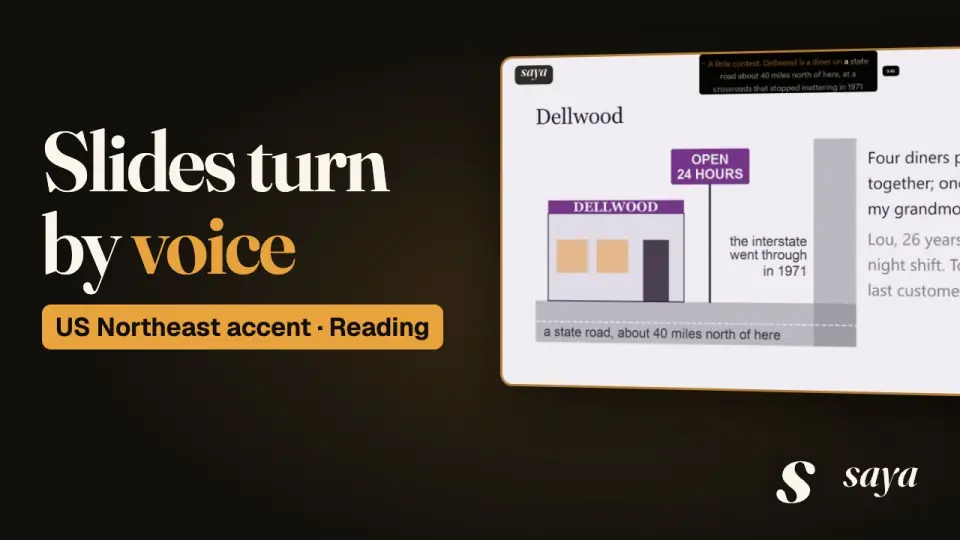 US Northeast accent, with slides“The Rest Is the Minute” · 4:37
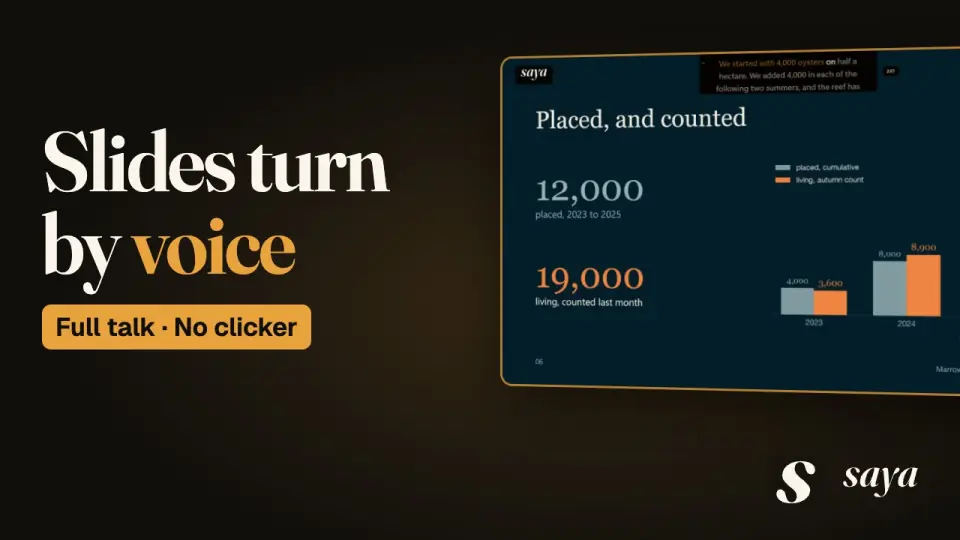 British accent, with slides“What Twelve Thousand Oysters Did” · 5:04
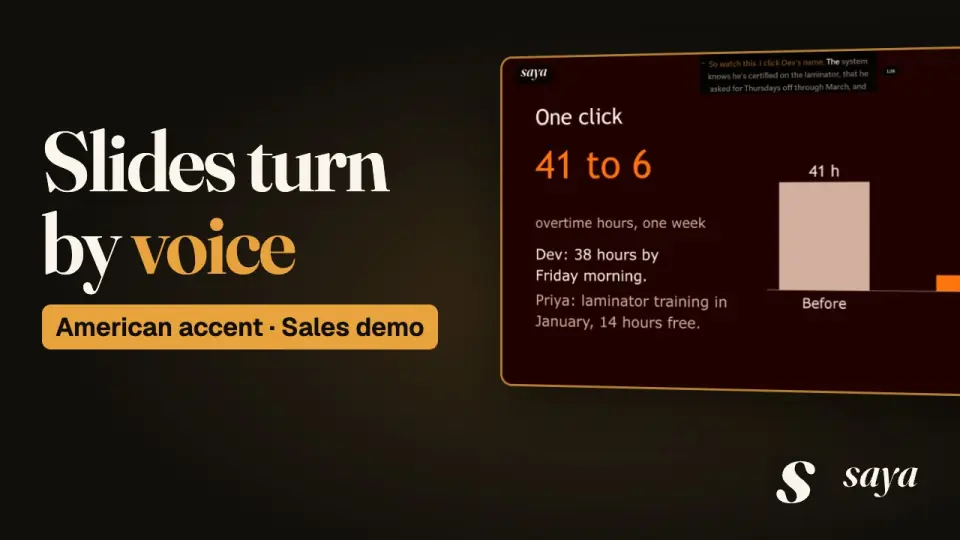 American accent, with slides“Two Stores, Thirty Days” · 4:53
 South African accent, with slides“Clean Water In, Honest Numbers Out” · 5:34
 New Zealand accent, with slides“It Was There the Whole Time” · 4:48