Slides That Follow Your Voice: Chinese Accent Startup Demo Day
Wei, co-founder of Lumo, pitches robots for small warehouses. SAYA shows the slides full screen and turns them as the talk reaches them. Along the way the voice goes off script, corrects itself, restarts a sentence, pauses and skips a line.
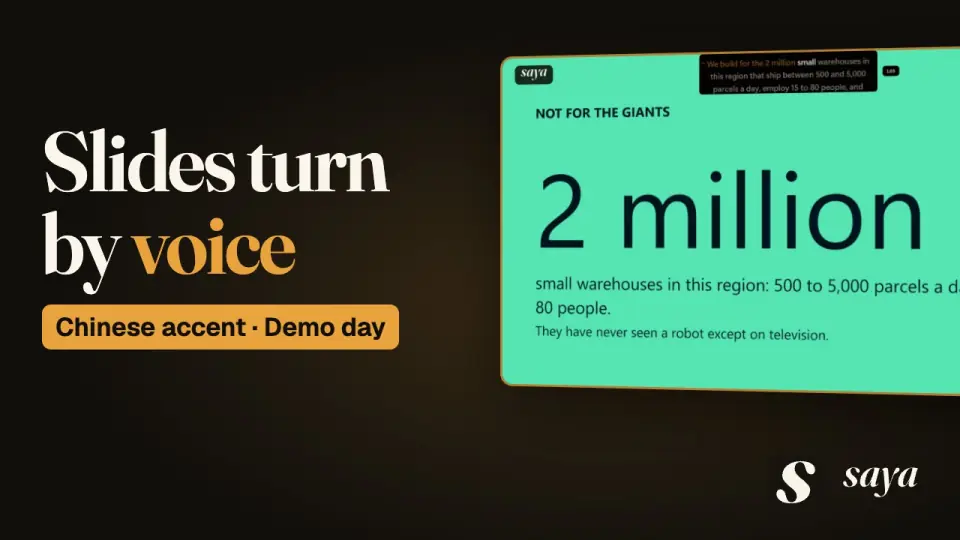
“The Shelves Come to You”, a scripted demo talk with slides on SAYA for Windows on a remote test server, in one take from start to finish, with opening and closing titles added. SAYA turns the slides as the talk reaches them. The voice reached SAYA through a virtual audio cable, not a room microphone. The accent name is the voice library's label.
Moments to watch
Select a time to play from there. A “…” marks where a quote starts or stops mid-sentence.
Off script0:45
She's in the photograph too. She's the one pointing. She's told me since that she wasn't pointing, she was indicating, and there's a difference, and I agreed, because she's my aunt and my first customer. She's waving now. Hi. Okay.
Said another way1:53
Friday night we put stickers on the floor, Monday morning the robots are running. That's basically it. The …
A slip and a fix2:02
My aunt's warehouse, which is also our first customer, and yes, she pays, went from one hundred and forty picks per person per hour to three hundred, sorry, three hundred and ninety. Picking errors fell from one point …
A false start3:15
Model, the business, business model. Business model.
A pause3:54
Between us we've written every line of the fleet software, and we've each personally carried a robot up three flights of stairs, which is why the next generation has a handle. We're raising four million to go from …
Transcript
The words of the talk as the voice says them, including its asides and slips. The text on screen is the script. While the film plays, the current paragraph is marked.
Slide 1: The shelves come to the picker
0:17Hi, everyone. I'm Wei, co-founder of Lumo, and I'm going to start with a photograph, because, basically, our business began with one. This is my aunt's warehouse in Dongguan. It's eighteen hundred square metres.
Slide 2: Dongguan: 40 of 61 standing still
0:31In twenty twenty-two, on the night of the biggest sale of the year, she had sixty-one people in it, and the photograph shows forty of them standing still, because the one person who knew where everything was had gone to the bathroom. [laughs] She's in the photograph too. She's the one pointing. She's told me since that she wasn't pointing, she was indicating, and there's a difference, and I agreed, because she's my aunt and my first customer. She's waving now. Hi. Okay.
1:00That's the problem we solve, and not for the giants, because the giants have robots and buildings the size of airports. We build for the two million small warehouses in this region that ship between five hundred and five thousand parcels a day, uh, employ fifteen to eighty people, and have never seen a robot except on television.
Slide 3: 2 million small warehouses
1:21Here's what we do, and I'll keep it short because the robots are behind me and they're more persuasive than I am. A Lumo system is a set of twelve small robots, each about the size of a suitcase, that carry shelves to a picker. The picker stands still and the shelves come to them.
Slide 4: A Lumo system
1:38The system learns which items sell together, so by week three, the shelf arriving at the picker has the next item they need on it about eighty-three percent of the time. There's no new building, no fixed rails, no conveyor. Friday night we put stickers on the floor, Monday morning the robots are running. That's basically it. The rest is software.
Slide 5: By week three: about 83 percent
2:01Numbers. My aunt's warehouse, which is also our first customer, and yes, she pays, went from one hundred and forty picks per person per hour to three hundred, sorry, three hundred and ninety. Picking errors fell from one point nine percent to zero point two.
Slide 6: First customer, and yes, she pays
2:18She hasn't laid anyone off. She's stopped hiring temporary workers for the sales, which used to cost her about two hundred and twenty thousand a year, and she's moved nine people from walking to packing, which is where the bottleneck actually was.
Slide 7: In the field
2:34We have three paying customers, forty-one robots in the field, and fourteen months of uptime data. Our worst month was ninety-seven point one percent availability, and that month was my fault, that month was my fault, because I pushed a software update at two in the morning before a holiday, which is a thing I will never do again, and which my co-founder has made into a poster. [sighs]
2:59The poster says, in very large letters, Wei, go to sleep. It's above my desk. It's also, I found out, on the back of the bathroom door, which, I mean. Anyway. It works. I sleep. [laughs]
3:15Model, the business, business model. Business model. We don't sell robots. We rent the system at three thousand eight hundred a month for twelve robots, including maintenance, software and a human being you can call. That's less than two temporary workers.
Slide 8: We rent the system. We do not sell robots.
3:33The hardware pays for itself in nineteen months, and our gross margin after that is seventy-one percent.
3:40Why us. My co-founder Lin spent nine years building navigation for mining vehicles, where a uh... a mistake costs a great deal more than a dropped parcel. I spent six years in logistics, mostly walking. [chuckles]
Slide 9: Why us
3:54Between us we've written every line of the fleet software, and we've each personally carried a robot up three flights of stairs, which is why the next generation has a handle.
4:07We're raising four million to go from three customers to thirty in the next eighteen months, and to build the second-generation robot, which is lighter, cheaper, and has the handle. And I was going to say something about the second generation's battery, because it, no, that's for the deck, right? It's in the deck. Page nine. If you run a warehouse, or know someone who does, the robots are awake, the floor is marked, and my aunt is on a video call in the corner, and she has opinions. She can see you. She's already asked me who the man in the third row is and whether he runs a warehouse. Sir, I apologise in advance. She will find you at the coffee.
Slide 10: Raising 4 million
4:50Thank you.
More demo films
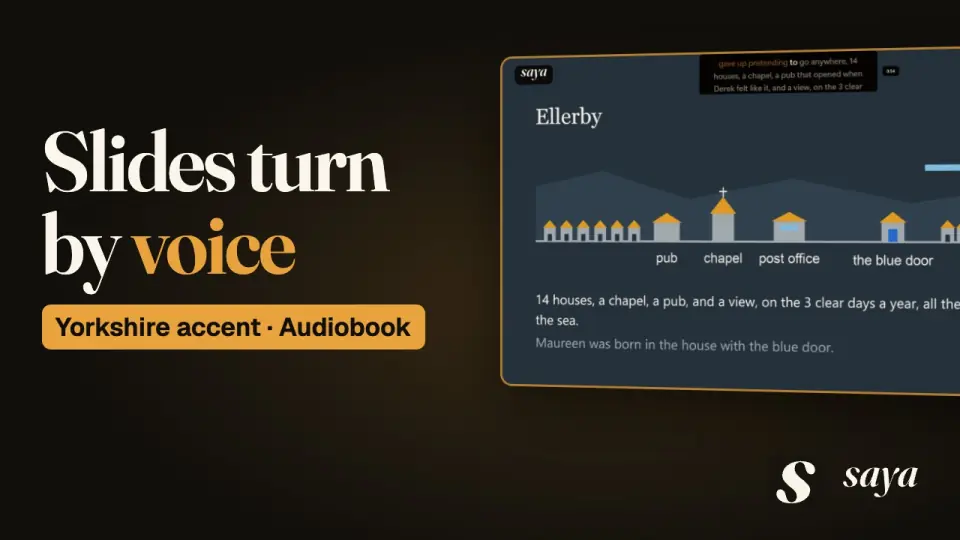 Yorkshire accent, with slides“We Shall See” · 4:24
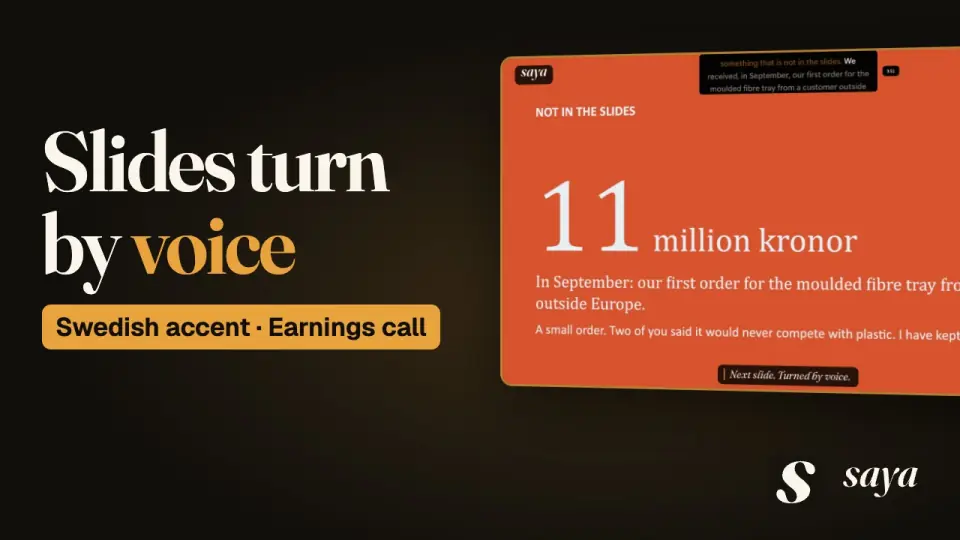 Swedish accent, with slides“Trees Do Not Read the News” · 5:00
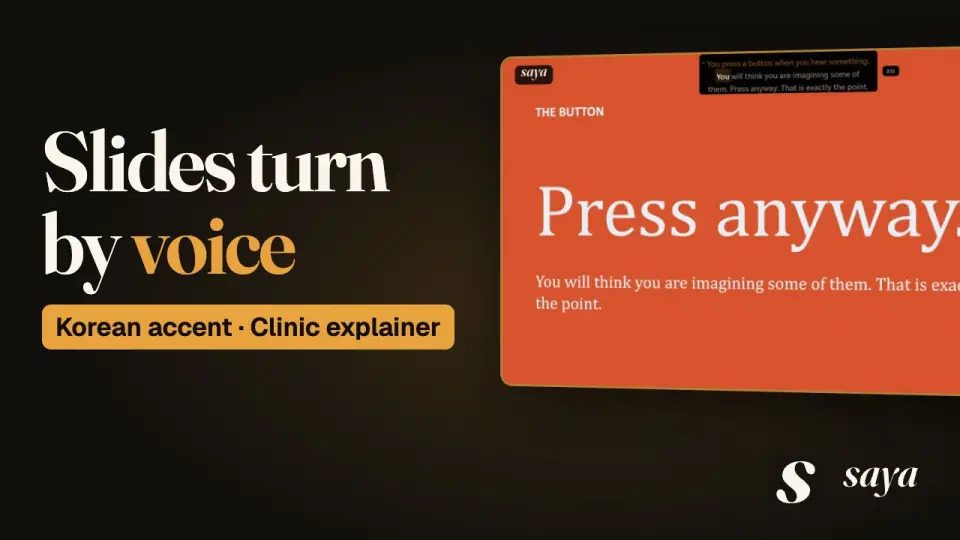 Korean accent, with slides“Press Anyway” · 5:06
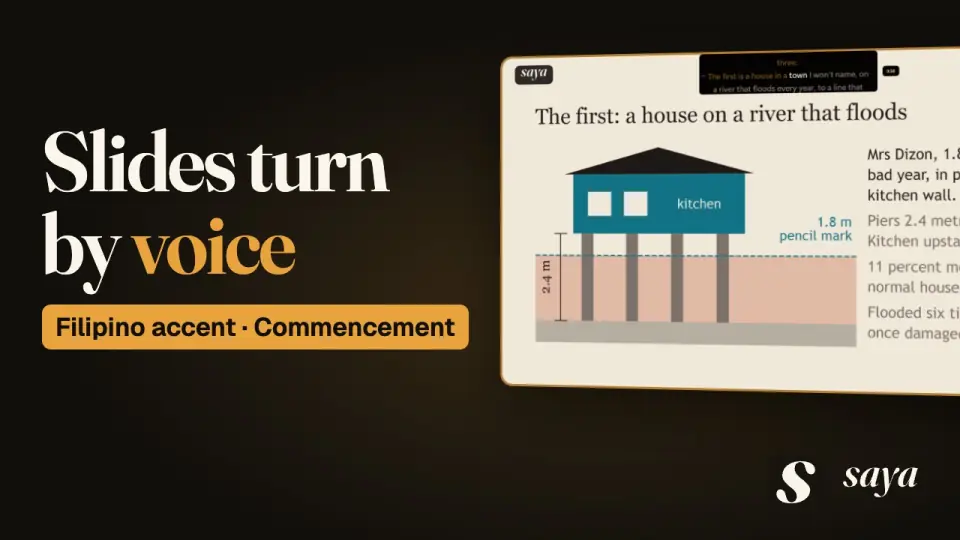 Filipino accent, with slides“Listen to the Pencil Marks” · 5:45
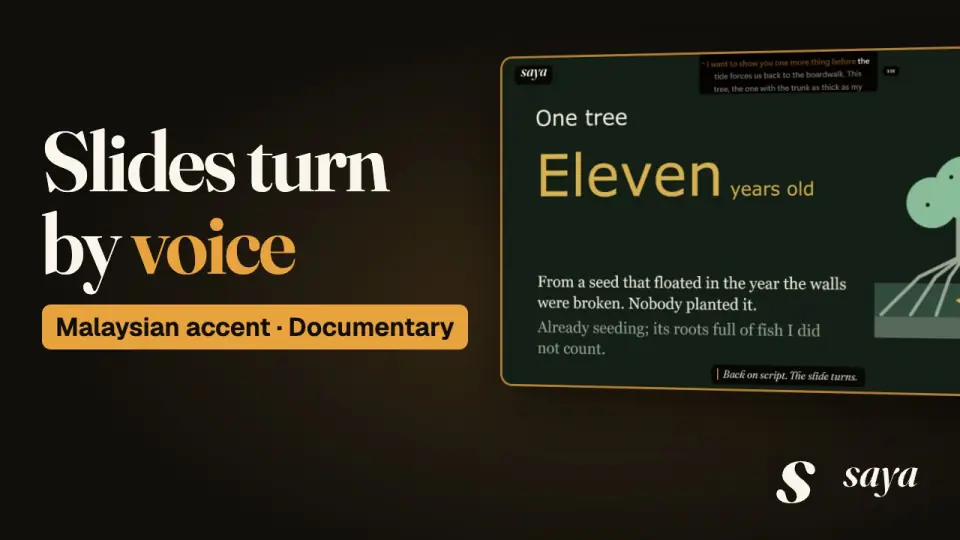 Malaysian accent, with slides“A Forest Allowed to Remember” · 5:00
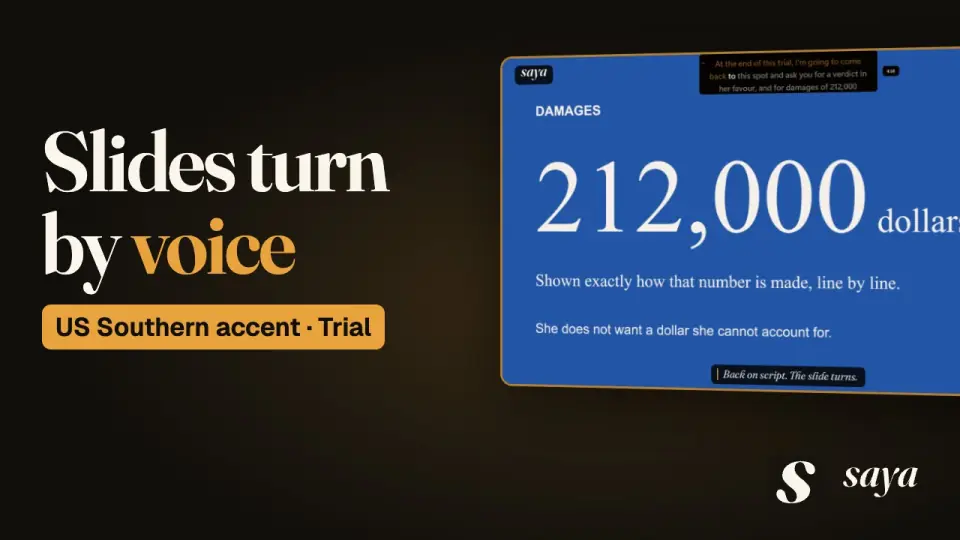 US Southern accent, with slides“Two Documents That Do Not Match” · 5:11