Slides That Follow Your Voice: British Accent Museum Tour
Rupert, keeper of maritime objects at the Hollins Collection, leads an evening tour through four rooms: a lighthouse lens with 1,032 hand-ground prisms, Edith Marrow, who kept the Carrow Point light from 1887 to 1902, the night of 948 millibars when nine ships sheltered in the bay, things the sea gave back, and a chronometer he still winds on Monday mornings. SAYA shows the slides full screen and turns them as the talk reaches them. Along the way the voice goes off script, corrects itself, restarts a sentence, pauses and skips a line.
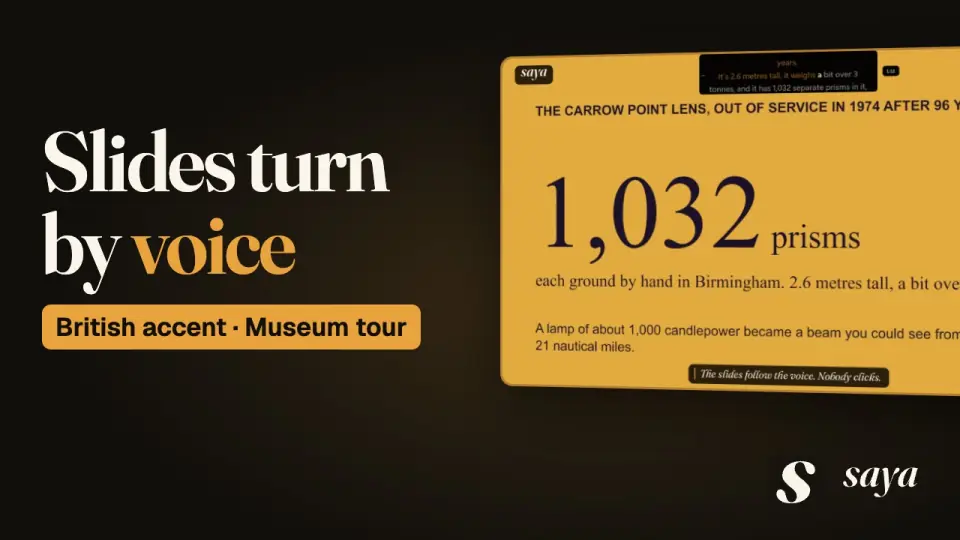
“Lamp Trimmed, All Well”, a scripted demo talk with slides on SAYA for Windows on a remote test server, in one take from start to finish, with opening and closing titles added. SAYA turns the slides as the talk reaches them. The voice reached SAYA through a virtual audio cable, not a room microphone. The accent name is the voice library's label.
Moments to watch
Select a time to play from there. A “…” marks where a quote starts or stops mid-sentence.
Off script0:37
I say tea. It's an urn, really, a large one, and it's older than I am, and the volunteers who run it have been running it since before I was born, so it goes at its own pace. …
A slip and a fix1:02
This is a first-order Fresnel lens from the Carrow Point light, taken out of service in nineteen seventy-four after ninety-five, no, ninety-six years, I think, yes, ninety-six years.
Said another way2:15
The board wrote to her, I think four times, asking her to go. The letters are on the left-hand wall, and her replies are on the right, and I'd ask you to notice that hers are shorter.
A false start2:31
On the, the night, no, let me do that properly. On the night of the eleventh of February eighteen ninety-four she recorded a barometer reading of nine hundred and forty-eight millibars, which is still the lowest anyone has …
A pause2:53
None of them was lost. The third room is quieter, and I'd ask you to be quiet in it.
Transcript
The words of the talk as the voice says them, including its asides and slips. The text on screen is the script. While the film plays, the current paragraph is marked.
Slide 1: The Hollins Collection
0:17Good evening, and welcome to the Hollins Collection. My name's Rupert, I look after the maritime objects here, and for the next hour or so I'm afraid you're mine. [chuckles]
0:27We'll go through four rooms, I'll talk rather too much, and at the end there's tea, which is the one promise this museum has kept without interruption since nineteen eleven. I say tea. It's an urn, really, a large one, and it's older than I am, and the volunteers who run it have been running it since before I was born, so it goes at its own pace. There was talk of replacing it. There's a committee. I'm on it. We've met twice. Anyway. Where was I. [laughs]
0:56We'll begin with the object you're standing next to, and do stand next to it rather than on it, if you would. This is a first-order Fresnel lens from the Carrow Point light, taken out of service in nineteen seventy-four after ninety-five, no, ninety-six years, I think, yes, ninety-six years.
1:15It's two point six metres tall, it weighs a bit over three tonnes, Yes, you, sir, thank you. and it has one thousand and thirty-two separate what do you call them, the, uh, prisms in it, each one ground by hand in a workshop in Birmingham that doesn't exist any more. When it was lit, a paraffin lamp of about one thousand candlepower became a beam you could see from twenty-one nautical miles.
Slide 2: 1,032 prisms: the Carrow Point lens
1:39It doesn't make more light, as it were, it just doesn't waste any, which is rather the point of it. The case is new, the lighting in this room isn't good, we know, there's a form. No? Well. It's a good form.
Slide 3: It doesn't make more light
1:53Through the arch, then, into the keepers' room. The log book in the glass case was kept by a woman called Edith Marrow, who ran the Carrow Point light on her uh... her own from eighteen eighty-seven to nineteen oh two, after her husband was lost from the relief boat.
2:09Keepers were paid seventy-two pounds a year, and widows, officially, weren't keepers at all. The board wrote to her, I think four times, asking her to go. The letters are on the left-hand wall, and her replies are on the right, and I'd ask you to notice that hers are shorter.
Slide 4: Edith Marrow, keeper, 1887 to 1902
2:25She logged every vessel that passed, every change of wind, every hour the lamp burned. On the, the night, no, let me do that properly. On the night of the eleventh of February eighteen ninety-four she recorded a barometer reading of nine hundred and forty-eight millibars, which is still the lowest anyone has written down on this coast, and then, in the same hand, the words, lamp trimmed, all well.
Slide 5: 948 millibars, February 1894
2:50Nine ships sheltered in the bay that night. None of them was lost.
Slides 6-7: Nine ships sheltered in the bay / Things the sea gave back
2:57The third room is quieter, and I'd ask you to be quiet in it. A child's boot. A brass sextant with somebody's initials on it. A wedding ring found inside a cod in nineteen thirty-one, which the fishmonger, to his eternal credit, took to the police station rather than the pawnbroker. [sighs]
3:17We don't know whose it was, and we've rather stopped pretending we might find out. We keep it because somebody ought to.
Slide 8: The Agnes Varley chronometer
3:25In the last room we have the chronometer from the schooner Agnes Varley. It still keeps time to within two seconds a day and it hasn't been serviced since nineteen fifty-eight, which I'm told is not how one is supposed to look after a chronometer. I wind it on Monday mornings. It's the only part of my job my daughter thinks is any good. [laughs] She's fourteen. Last year she asked whether the museum had a Wi-Fi password, and I said yes, it's eighteen eighty-seven, and she hasn't really spoken to me about my work since. The chronometer, though. She'll watch me wind that. I don't know why. I've never asked, actually, in case the answer's disappointing.
4:02People sometimes ask what a museum like this is for, now that there are satellites and a lighthouse is somewhere to have a picnic. I don't have a tidy answer, I'm afraid. I think it's this.
4:14Everything in these rooms was made by someone who assumed the dark would always be dangerous, and so they did the job properly, did the job properly. Edith Marrow trimmed the lamp with nine hundred and forty-eight millibars sitting on the roof. The prism grinder got the one thousand and thirty-second prism right. I find that steadying, and I'm not sure I can explain why.
Slide 9: They assumed the dark would always be dangerous
4:39Right. Tea is through the blue door, the biscuits are not historical, and I'll be by the lens if anyone has questions. Sorry, I've lost my place. The, um. Yes. Right. Thank you for coming.
More demo films
 Portuguese accent, with slides“More Boat Than Hole” · 4:21
 Irish accent, with slides“The Girl in the Shed” · 4:27
 Jamaican accent, with slides“A Shell and Not a Prayer” · 4:55
 Australian accent, with slides“One Microwave, Retired with Honours” · 4:27
 Spanish accent, with slides“The Tree That Writes Everything Down” · 5:03
 Singaporean accent, with slides“Useful in Both Directions” · 4:49